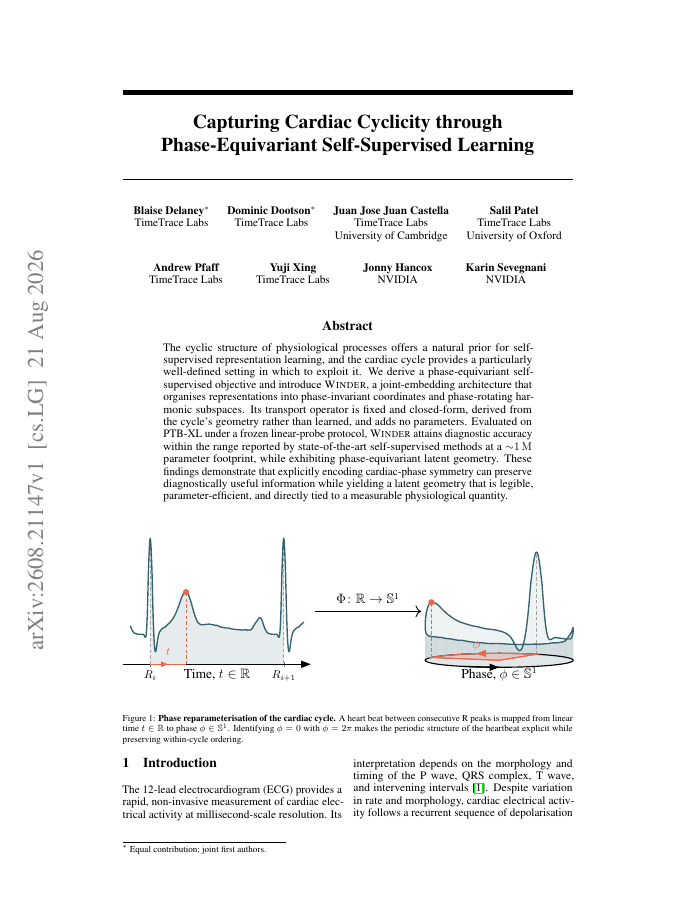
The cyclic structure of physiological processes offers a natural prior for self-supervised representation learning, and the cardiac cycle provides a particularly well-defined setting in which to exploit it. We derive a phase-equivariant self-supervised objective and introduce Winder, a joint-embedding architecture that organises representations into phase-invariant coordinates and phase-rotating harmonic subspaces. Its transport operator is fixed and closed-form, derived from the cycle's geometry rather than learned, and adds no parameters. Evaluated on PTB-XL under a frozen linear-probe protocol, Winder attains diagnostic accuracy within the range reported by state-of-the-art self-supervised methods at a 1 M parameter footprint, while exhibiting phase-equivariant latent geometry. These findings demonstrate that explicitly encoding cardiac-phase symmetry can preserve diagnostically useful information while yielding a latent geometry that is legible, parameter-efficient, and directly tied to a measurable physiological quantity.
Capturing Cardiac Cyclicity through Phase-Equivariant Self-Supervised Learning
The cyclic structure of physiological processes offers a natural prior for self-supervised representation learning, and the cardiac cycle provides a particularly well-defined setting in which to exploit it.
- Preview
- Year
- 2026
- Hosting
- Full text hostedCC-BY-4.0
Cite
Notes
Only stored in your browser.
Attribution
- Abstract & full text
- arxiv.org/abs/2608.21147CC-BY-4.0
- TL;DR
- Semantic Scholar