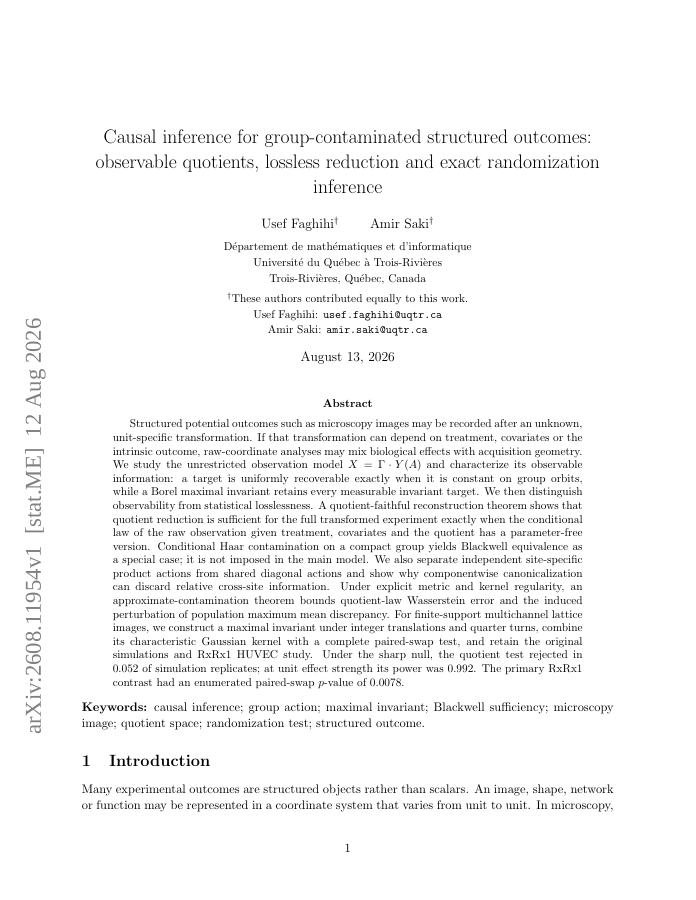
Structured potential outcomes such as microscopy images may be recorded after an unknown, unit-specific transformation. If that transformation can depend on treatment, covariates or the intrinsic outcome, raw-coordinate analyses may mix biological effects with acquisition geometry. We study the unrestricted observation model X = Γ . Y(A) and characterize its observable information: a target is uniformly recoverable exactly when it is constant on group orbits, while a Borel maximal invariant retains every measurable invariant target. We then distinguish observability from statistical losslessness. A quotient-faithful reconstruction theorem shows that quotient reduction is sufficient for the full transformed experiment exactly when the conditional law of the raw observation given treatment, covariates and the quotient has a parameter-free version. Conditional Haar contamination on a compact group yields Blackwell equivalence as a special case; it is not imposed in the main model. We also separate independent site-specific product actions from shared diagonal actions and show why componentwise canonicalization can discard relative cross-site information. Under explicit metric and kernel regularity, an approximate-contamination theorem bounds quotient-law Wasserstein error and the induced perturbation of population maximum mean discrepancy. For finite-support multichannel lattice images, we construct a maximal invariant under integer translations and quarter turns, combine its characteristic Gaussian kernel with a complete paired-swap test, and retain the original simulations and RxRx1 HUVEC study. Under the sharp null, the quotient test rejected in 0.052 of simulation replicates; at unit effect strength its power was 0.992. The primary RxRx1 contrast had an enumerated paired-swap p-value of 0.0078.
Causal inference for group-contaminated structured outcomes: observable quotients, lossless reduction and exact randomization inference
Structured potential outcomes such as microscopy images may be recorded after an unknown, unit-specific transformation. If that transformation can depend on treatment, covariates or the intrinsic outcome, raw-coordinate analyses may mix biological effects with acquisition…
- Preview
- Year
- 2026
- Hosting
- Excerpt onlyCC-BY-NC-SA-4.0
Cite
Notes
Only stored in your browser.
Attribution
- Abstract & full text
- arxiv.org/abs/2608.11954CC-BY-NC-SA-4.0
- TL;DR
- Semantic Scholar