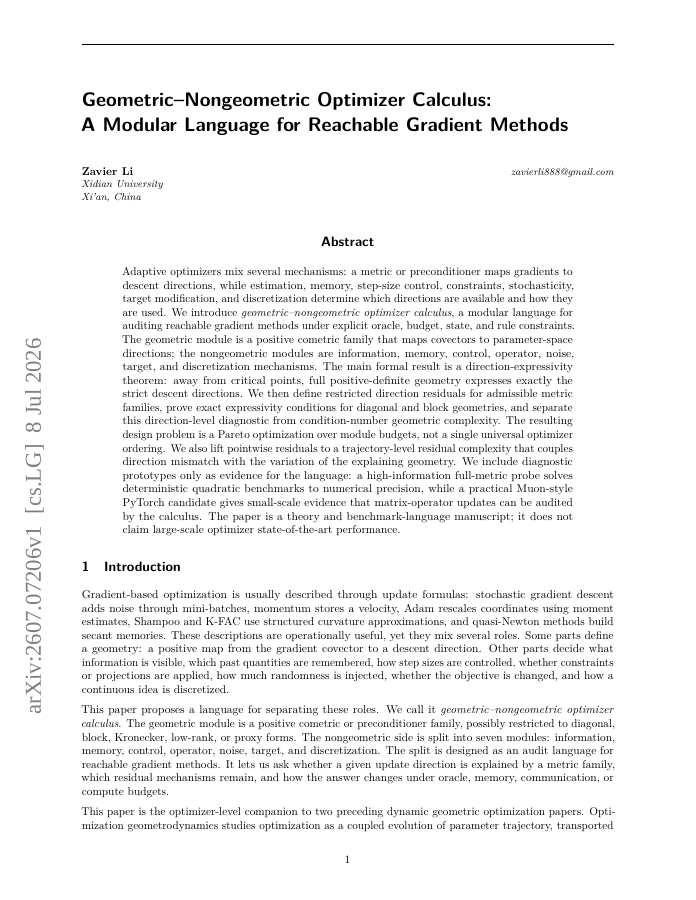
Optimizer experiments observe responses to algorithmic configurations without uniquely revealing hidden mechanisms. We develop a causal optimizer interaction calculus that separates pathwise realization, Mobius decomposition, and experimental identification. Under a fixed innovation coupling, every finite-horizon innovation-driven optimizer admits a behaviorally minimal pathwise realization. For any finite effect support and intervention design, an incidence operator gives the complete observational gauge, exact identifiability, sharp quotient stability, held-out predictions, and exact noiseless configuration complexity. Smooth hidden relaxation generates interactions through inverse hidden-state stiffness. Building on this structural law, we prove an observable-readout transfer theorem: arbitrary smooth update or trace readouts inherit an explicit five-term interaction through first and second hidden responses. Unlike the reduced optimal value, a general readout has no universal interaction sign. Its Boolean effects remain exact integrals of continuous interaction curvature and can therefore be identified by factorial interventions. We also derive Gaussian quotient minimax risk, exact confidence sets and tests, misspecification decomposition, certified downstream decisions, and optimal replication. A controlled real-data experiment on a 65-dimensional strongly convex logistic model validates the complete reduced-value chain. Boolean effects and independently integrated curvature agree within 4.21e-11, while nine held-out continuous intensities agree within 8.88e-13. Gaussian campaigns attain the predicted coverage and power, and 4,500 real-minibatch observations reject an order-two interaction model. Neural trace audits provide complementary evidence that the declared response classes remain informative in nonconvex training.
Causal Optimizer Interaction Calculus: Hidden Geometric Relaxation and Identifiable Interventions
Optimizer experiments observe responses to algorithmic configurations without uniquely revealing hidden mechanisms. We develop a causal optimizer interaction calculus that separates pathwise realization, Mobius decomposition, and experimental identification.
- Preview
- Year
- 2026
- Hosting
- Full text hostedCC-BY-4.0
Cite
Notes
Only stored in your browser.
Attribution
- Abstract & full text
- arxiv.org/abs/2607.07206CC-BY-4.0
- TL;DR
- Semantic Scholar