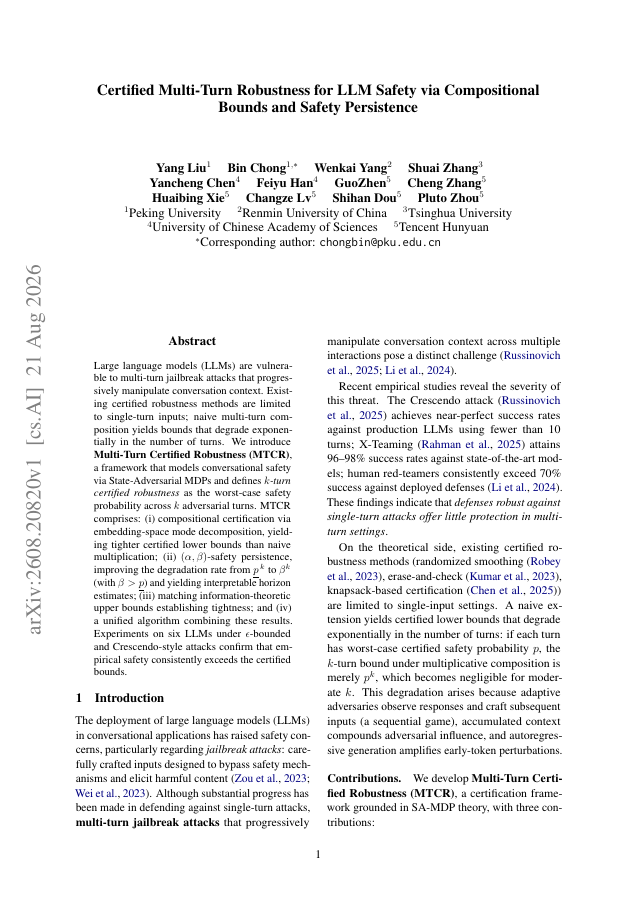
Large language models (LLMs) are vulnerable to multi-turn jailbreak attacks that progressively manipulate conversation context. Existing certified robustness methods are limited to single-turn inputs; naive multi-turn composition yields bounds that degrade exponentially in the number of turns. We introduce Multi-Turn Certified Robustness (MTCR), a framework that models conversational safety via State-Adversarial MDPs and defines k-turn certified robustness as the worst-case safety probability across k adversarial turns. MTCR comprises: (i) compositional certification via embedding-space mode decomposition, yielding tighter certified lower bounds than naive multiplication; (ii) (α,β)-safety persistence, improving the degradation rate from \underline{p}^{k} to β^k (with β> \underline{p}) and yielding interpretable horizon estimates; (iii) matching information-theoretic upper bounds establishing tightness; and (iv) a unified algorithm combining these results. Experiments on six LLMs under ε-bounded and Crescendo-style attacks confirm that empirical safety consistently exceeds the certified bounds.
Certified Multi-Turn Robustness for LLM Safety via Compositional Bounds and Safety Persistence
Large language models (LLMs) are vulnerable to multi-turn jailbreak attacks that progressively manipulate conversation context. Existing certified robustness methods are limited to single-turn inputs; naive multi-turn composition yields bounds that degrade exponentially in the…
- Preview
- Year
- 2026
- Hosting
- Full text hostedCC-BY-4.0
Cite
Notes
Only stored in your browser.
Attribution
- Abstract & full text
- arxiv.org/abs/2608.20820CC-BY-4.0
- TL;DR
- Semantic Scholar