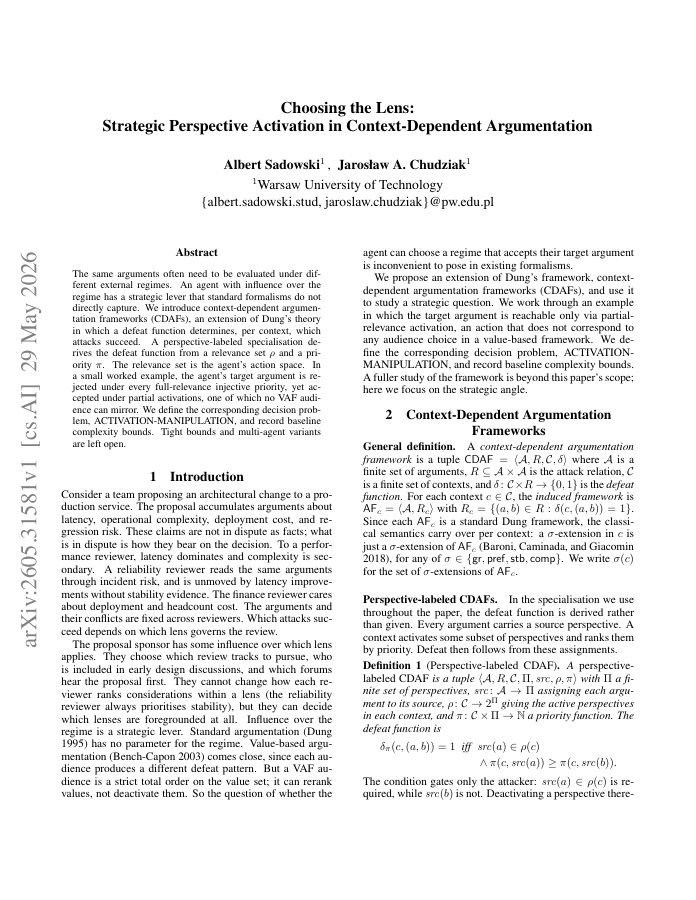
The same arguments often need to be evaluated under different external regimes. An agent with influence over the regime has a strategic lever that standard formalisms do not directly capture. We introduce context-dependent argumentation frameworks (CDAFs), an extension of Dung's theory in which a defeat function determines, per context, which attacks succeed. Blocked attacks are inverted rather than deleted, so extensions stay conflict-free with respect to the attack relation. A perspective-labeled specialisation derives the defeat function from a relevance set ρ and a priority π. The relevance set is the agent's action space. In a small worked example, the agent's target argument is rejected under every full-relevance priority, yet accepted under a partial activation whose outcome no VAF audience can mirror. We define the corresponding decision problem, ACTIVATION-MANIPULATION, and record baseline complexity bounds. For grounded semantics with mandatory perspectives the problem is NP-complete, and the hardness comes from the activation choice itself.
Choosing the Lens: Strategic Perspective Activation in Context-Dependent Argumentation
The same arguments often need to be evaluated under different external regimes. An agent with influence over the regime has a strategic lever that standard formalisms do not directly capture.
- Preview
- Year
- 2026
- Hosting
- Full text hostedCC-BY-4.0
Cite
Notes
Only stored in your browser.
Attribution
- Abstract & full text
- arxiv.org/abs/2605.31581CC-BY-4.0
- TL;DR
- Semantic Scholar