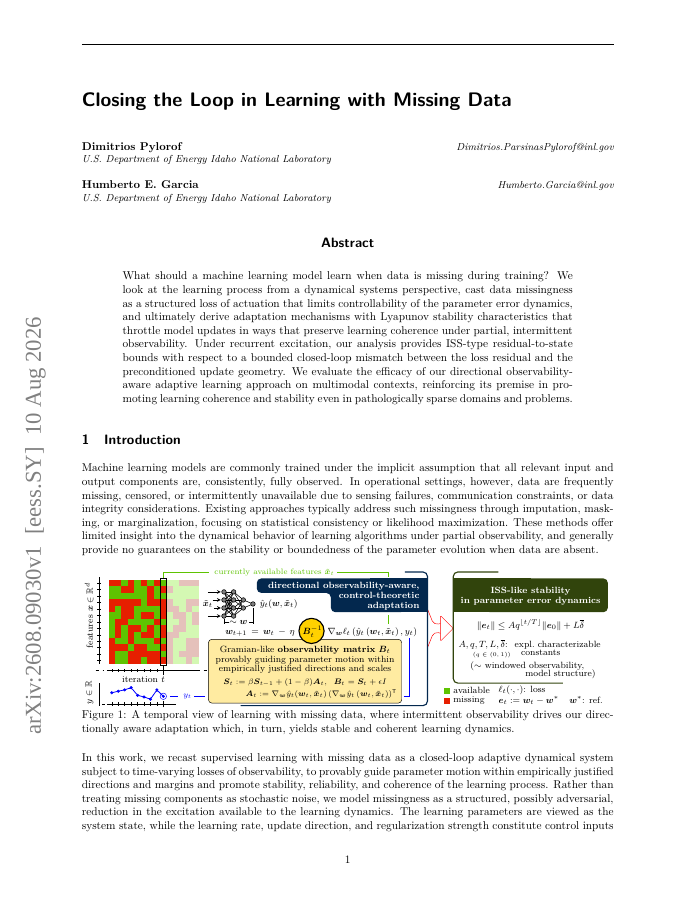
What should a machine learning model learn when data is missing during training? We look at the learning process from a dynamical systems perspective, cast data missingness as a structured loss of actuation that limits controllability of the parameter error dynamics, and ultimately derive adaptation mechanisms with Lyapunov stability characteristics that throttle model updates in ways that preserve learning coherence under partial, intermittent observability. Under recurrent excitation, our analysis provides ISS-type residual-to-state bounds with respect to a bounded closed-loop mismatch between the loss residual and the preconditioned update geometry. We evaluate the efficacy of our directional observability-aware adaptive learning approach on multimodal contexts, reinforcing its premise in promoting learning coherence and stability even in pathologically sparse domains and problems.
Closing the loop in learning with missing data
What should a machine learning model learn when data is missing during training? We look at the learning process from a dynamical systems perspective, cast data missingness as a structured loss of actuation that limits controllability of the parameter error dynamics, and…
- Preview
- Year
- 2026
- Hosting
- Excerpt onlyCC-BY-NC-4.0
Cite
Notes
Only stored in your browser.
Attribution
- Abstract & full text
- arxiv.org/abs/2608.09030CC-BY-NC-4.0
- TL;DR
- Semantic Scholar