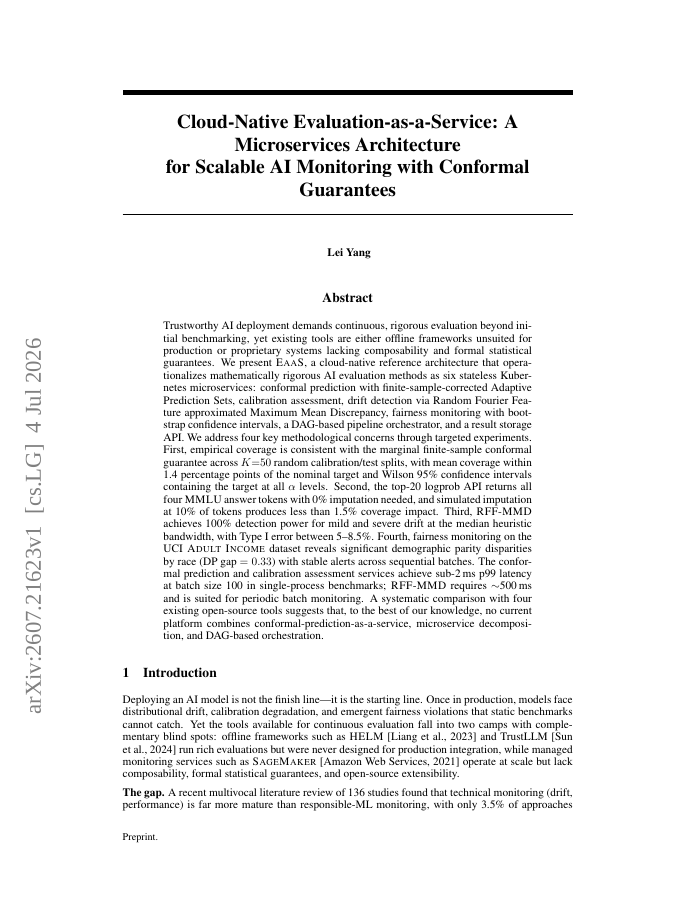
We present EaaS, a cloud-native reference architecture that operationalizes AI evaluation methods as six stateless Kubernetes microservices: conformal prediction with finite-sample-corrected Adaptive Prediction Sets, calibration assessment, drift detection via RFF-approximated Maximum Mean Discrepancy, fairness monitoring with bootstrap confidence intervals, a DAG-based pipeline orchestrator, and a result storage API. We validate four key methodological concerns. First, empirical coverage is consistent with the marginal conformal guarantee across K=50 random calibration/test splits, with mean coverage within 1.4 percentage points of the nominal target. Second, all four MMLU answer tokens appear in the top-20 logprobs with 0% imputation needed, and simulated imputation at 10% produces less than 1.5% coverage impact. Third, RFF-MMD achieves 100% detection power for mild and severe drift at the median heuristic bandwidth, with Type I error between 5-8.5%. Fourth, fairness monitoring on the UCI Adult Income dataset reveals significant demographic parity disparities by race (DP gap=0.33) with stable alerts across sequential batches. Conformal prediction and calibration services achieve sub-2ms p99 latency at batch size 100; RFF-MMD requires 500ms suited for periodic batch monitoring. A comparison with four open-source tools suggests that, to the best of our knowledge, no current platform combines conformal-prediction-as-a-service, microservice decomposition, and DAG-based orchestration.
Cloud-Native Evaluation-as-a-Service: A Microservices Architecture for Scalable AI Monitoring with Conformal Guarantees
We present EaaS, a cloud-native reference architecture that operationalizes AI evaluation methods as six stateless Kubernetes microservices: conformal prediction with finite-sample-corrected Adaptive Prediction Sets, calibration assessment, drift detection via RFF-approximated…
- Preview
- Year
- 2026
- Hosting
- Full text hostedCC-BY-4.0
Cite
Notes
Only stored in your browser.
Attribution
- Abstract & full text
- arxiv.org/abs/2607.21623CC-BY-4.0
- TL;DR
- Semantic Scholar