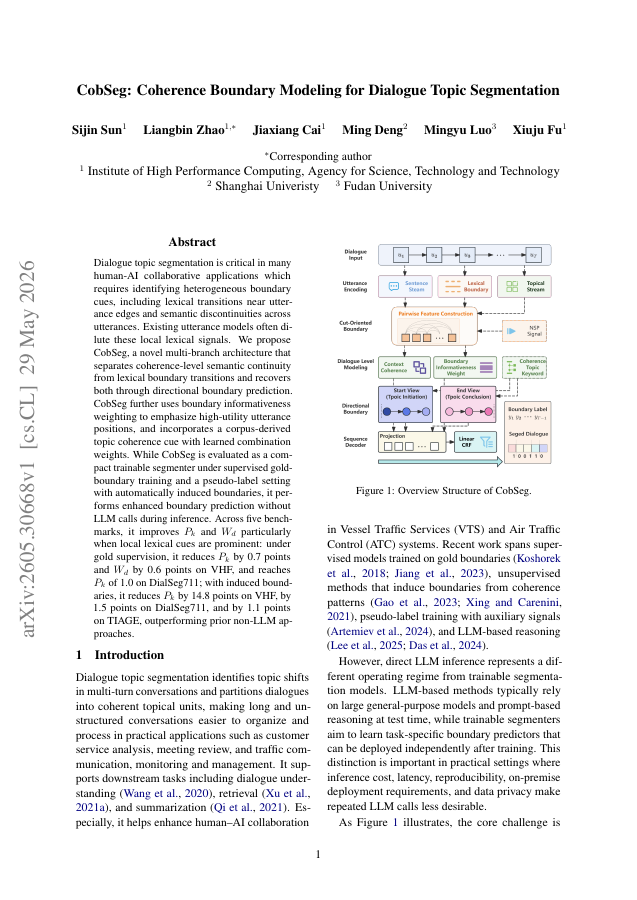
Dialogue topic segmentation is critical in many human-AI collaborative applications which requires identifying heterogeneous boundary cues, including lexical transitions near utterance edges and semantic discontinuities across utterances. Existing utterance models often dilute these local lexical signals. We propose CobSeg, a novel multi-branch architecture that separates coherence-level semantic continuity from lexical boundary transitions and recovers both through directional boundary prediction. CobSeg further uses boundary informativeness weighting to emphasize high-utility utterance positions, and incorporates a corpus-derived topic coherence cue with learned combination weights. While CobSeg is evaluated as a compact trainable segmenter under supervised gold-boundary training and a pseudo-label setting with automatically induced boundaries, it performs enhanced boundary prediction without LLM calls during inference. Across five benchmarks, it improves P_k and W_d particularly when local lexical cues are prominent: under gold supervision, it reduces P_k by 0.7 points and W_d by 0.6 points on VHF, and reaches P_k of 1.0 on DialSeg711; with induced boundaries, it reduces P_k by 14.8 points on VHF, by 1.5 points on DialSeg711, and by 1.1 points on TIAGE, outperforming prior non-LLM approaches.
CobSeg: Coherence Boundary Modeling for Dialogue Topic Segmentation
Dialogue topic segmentation is critical in many human-AI collaborative applications which requires identifying heterogeneous boundary cues, including lexical transitions near utterance edges and semantic discontinuities across utterances.
- Preview
- Year
- 2026
- Hosting
- Abstract onlyARXIV-DEFAULT
Cite
Notes
Only stored in your browser.
Attribution
- Abstract & full text
- arxiv.org/abs/2605.30668ARXIV-DEFAULT
- TL;DR
- Semantic Scholar