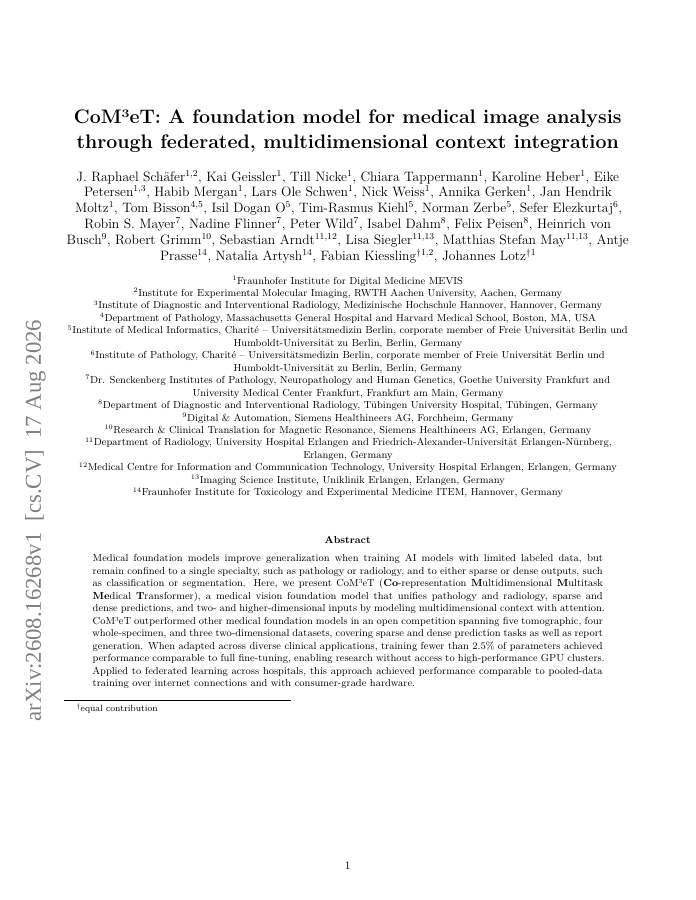
Medical foundation models improve generalization when training AI models with limited labeled data, but remain confined to a single specialty, such as pathology or radiology, and to either sparse or dense outputs, such as classification or segmentation. Here, we present CoM^3eT (Co-representation Multidimensional Multitask Medical Transformer), a medical vision foundation model that unifies pathology and radiology, sparse and dense predictions, and two- and higher-dimensional inputs by modeling multidimensional context with attention. CoM^3eT outperformed other medical foundation models in an open competition spanning five tomographic, four whole-specimen, and three two-dimensional datasets, covering sparse and dense prediction tasks as well as report generation. When adapted across diverse clinical applications, training fewer than 2.5% of parameters achieved performance comparable to full fine-tuning, enabling research without access to high-performance GPU clusters. Applied to federated learning across hospitals, this approach achieved performance comparable to pooled-data training over internet connections and with consumer-grade hardware.
CoM$^3$eT: A foundation model for medical image analysis through federated, multidimensional context integration
Medical foundation models improve generalization when training AI models with limited labeled data, but remain confined to a single specialty, such as pathology or radiology, and to either sparse or dense outputs, such as classification or segmentation.
- Preview
- Year
- 2026
- Hosting
- Full text hostedCC-BY-4.0
Cite
Notes
Only stored in your browser.
Attribution
- Abstract & full text
- arxiv.org/abs/2608.16268CC-BY-4.0
- TL;DR
- Semantic Scholar