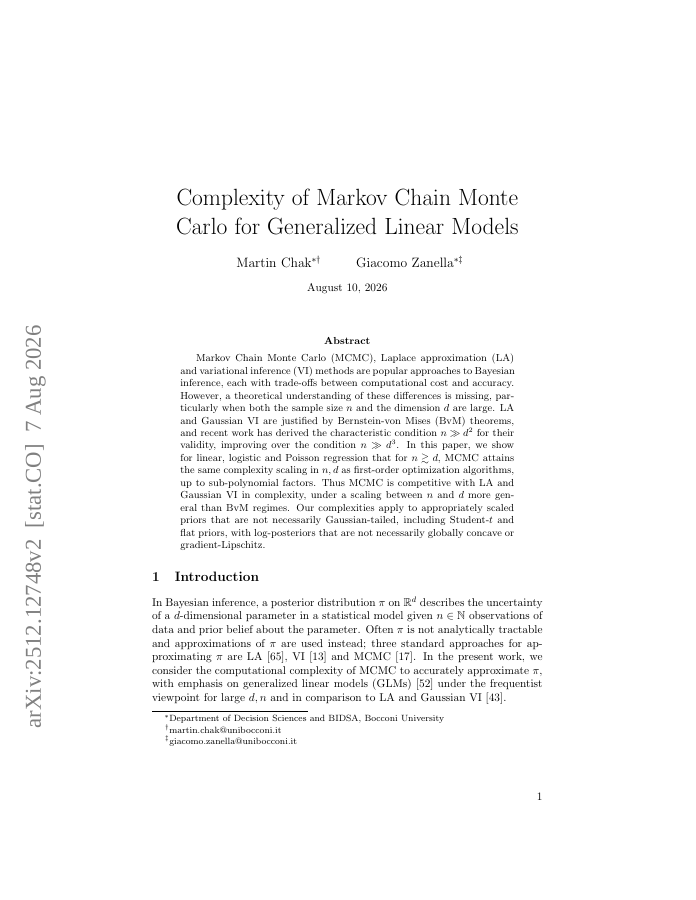
Markov Chain Monte Carlo (MCMC), Laplace approximation (LA) and variational inference (VI) methods are popular approaches to Bayesian inference, each with trade-offs between computational cost and accuracy. However, a theoretical understanding of these differences is missing, particularly when both the sample size n and the dimension d are large. LA and Gaussian VI are justified by Bernstein-von Mises (BvM) theorems, and recent work has derived the characteristic condition n\gg d^2 for their validity, improving over the condition n\gg d^3. In this paper, we show for linear, logistic and Poisson regression that for n\gtrsim d, MCMC attains the same complexity scaling in n, d as first-order optimization algorithms, up to sub-polynomial factors. Thus MCMC is competitive with LA and Gaussian VI in complexity, under a scaling between n and d more general than BvM regimes. Our complexities apply to appropriately scaled priors that are not necessarily Gaussian-tailed, including Student-t and flat priors, with log-posteriors that are not necessarily globally concave or gradient-Lipschitz.
Complexity of Markov Chain Monte Carlo for Generalized Linear Models
Markov Chain Monte Carlo (MCMC), Laplace approximation (LA) and variational inference (VI) methods are popular approaches to Bayesian inference, each with trade-offs between computational cost and accuracy.
- Preview
- Year
- 2025
- Hosting
- Abstract onlyARXIV-DEFAULT
Cite
Notes
Only stored in your browser.
Attribution
- Abstract & full text
- arxiv.org/abs/2512.12748ARXIV-DEFAULT
- TL;DR
- Semantic Scholar