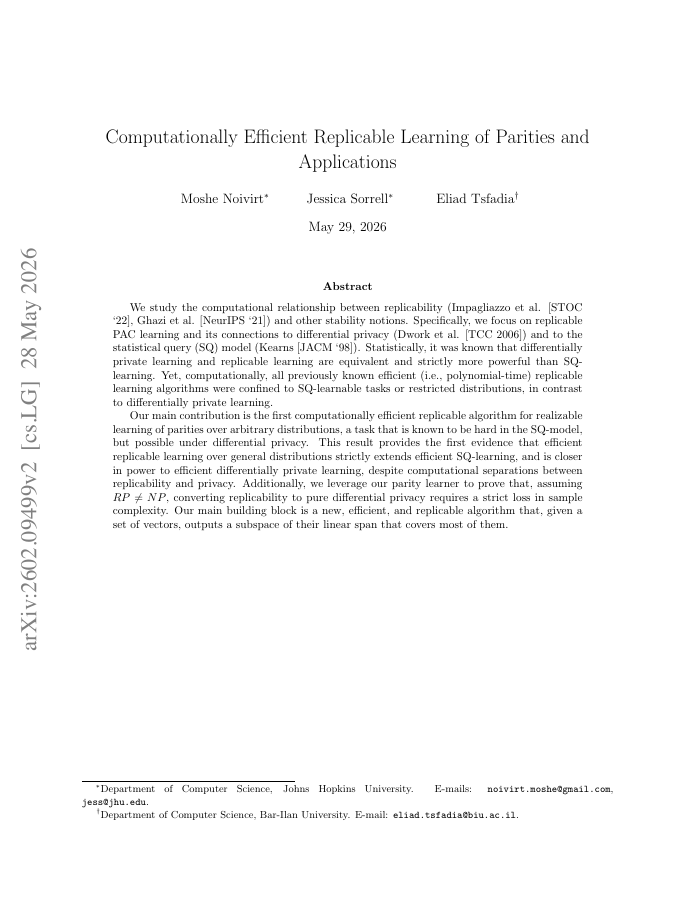
We study the computational relationship between replicability (Impagliazzo et al. [STOC 22], Ghazi et al. [NeurIPS 21]) and other stability notions. Specifically, we focus on replicable PAC learning and its connections to differential privacy (Dwork et al. [TCC 2006]) and to the statistical query (SQ) model (Kearns [JACM `98]). Statistically, it was known that differentially private learning and replicable learning are equivalent and strictly more powerful than SQ-learning. Yet, computationally, all previously known efficient (i.e., polynomial-time) replicable learning algorithms were confined to SQ-learnable tasks or restricted distributions, in contrast to differentially private learning.
Our main contribution is the first computationally efficient replicable algorithm for realizable learning of parities over arbitrary distributions, a task that is known to be hard in the SQ-model, but possible under differential privacy. This result provides the first evidence that efficient replicable learning over general distributions strictly extends efficient SQ-learning, and is closer in power to efficient differentially private learning, despite computational separations between replicability and privacy. Additionally, we leverage our parity learner to prove that, assuming RP \neq NP, converting replicability to pure differential privacy requires a strict loss in sample complexity. Our main building block is a new, efficient, and replicable algorithm that, given a set of vectors, outputs a subspace of their linear span that covers most of them.
Computationally Efficient Replicable Learning of Parities and Applications
We study the computational relationship between replicability (Impagliazzo et al. [STOC `22], Ghazi et al. [NeurIPS `21]) and other stability notions. Specifically, we focus on replicable PAC learning and its connections to differential privacy (Dwork et al.
- Preview
- Year
- 2026
- Hosting
- Abstract onlyARXIV-DEFAULT
Cite
Notes
Only stored in your browser.
Attribution
- Abstract & full text
- arxiv.org/abs/2602.09499ARXIV-DEFAULT
- TL;DR
- Semantic Scholar