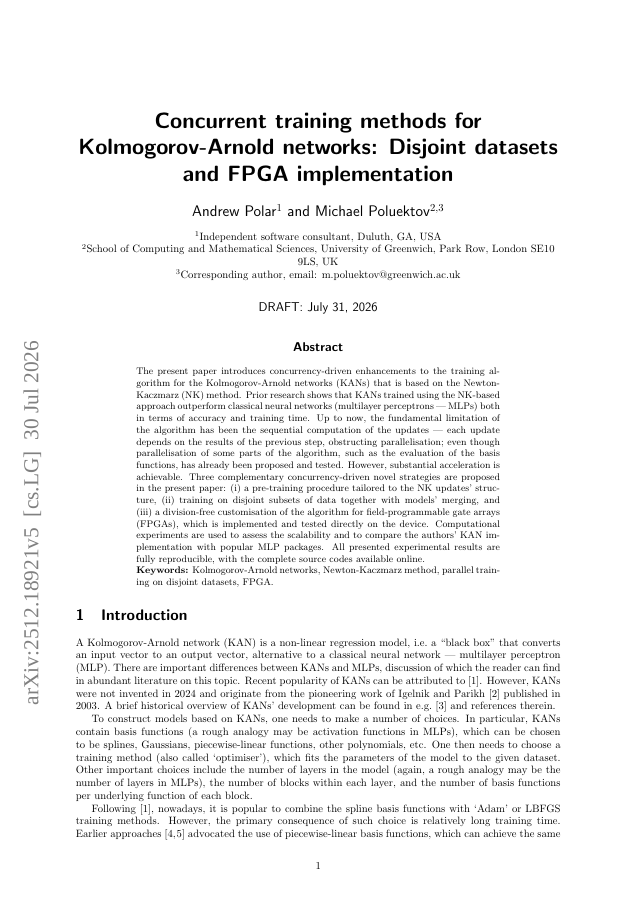
The present paper introduces concurrency-driven enhancements to the training algorithm for the Kolmogorov-Arnold networks (KANs) that is based on the Newton-Kaczmarz (NK) method. Prior research shows that KANs trained using the NK-based approach outperform classical neural networks (multilayer perceptrons - MLPs) both in terms of accuracy and training time. Up to now, the fundamental limitation of the algorithm has been the sequential computation of the updates - each update depends on the results of the previous step, obstructing parallelisation; even though parallelisation of some parts of the algorithm, such as the evaluation of the basis functions, has already been proposed and tested. However, substantial acceleration is achievable. Three complementary concurrency-driven novel strategies are proposed in the present paper: (i) a pre-training procedure tailored to the NK updates' structure, (ii) training on disjoint subsets of data together with models' merging, and (iii) a division-free customisation of the algorithm for field-programmable gate arrays (FPGAs), which is implemented and tested directly on the device. Computational experiments are used to assess the scalability and to compare the authors' KAN implementation with popular MLP packages. All presented experimental results are fully reproducible, with the complete source codes available online.
Concurrent training methods for Kolmogorov-Arnold networks: Disjoint datasets and FPGA implementation
The present paper introduces concurrency-driven enhancements to the training algorithm for the Kolmogorov-Arnold networks (KANs) that is based on the Newton-Kaczmarz (NK) method.
- Preview
- Year
- 2025
- Hosting
- Full text hostedCC-BY-4.0
Cite
Notes
Only stored in your browser.
Attribution
- Abstract & full text
- arxiv.org/abs/2512.18921CC-BY-4.0
- TL;DR
- Semantic Scholar