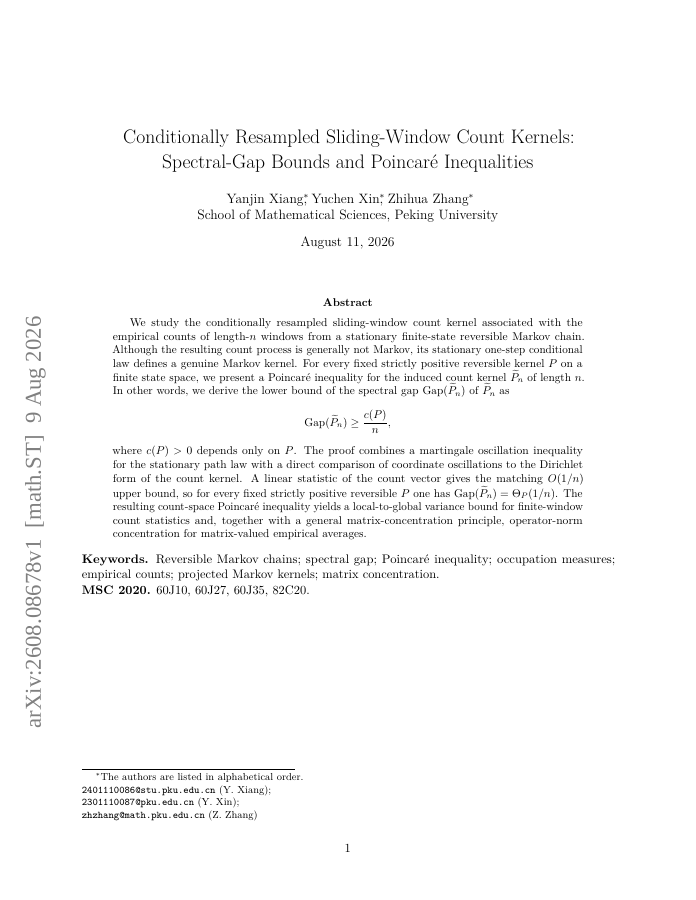
We study the conditionally resampled sliding-window count kernel associated with the empirical counts of length-n windows from a stationary finite-state reversible Markov chain. Although the resulting count process is generally not Markov, its stationary one-step conditional law defines a genuine Markov kernel. For every fixed strictly positive reversible kernel P on a finite state space, we present a Poincaré inequality for the induced count kernel \tP_n of length n. In other words, we derive the lower bound of the spectral gap \Gap(\tP_n) of \tP_n as [ \Gap(\tP_n)\ge \frac{c(P)}{n}, ] where c(P)>0 depends only on P. The proof combines a martingale oscillation inequality for the stationary path law with a direct comparison of coordinate oscillations to the Dirichlet form of the count kernel. A linear statistic of the count vector gives the matching O(1/n) upper bound, so for every fixed strictly positive reversible P one has \Gap(\tP_n)=Θ_P(1/n). The resulting count-space Poincaré inequality yields a local-to-global variance bound for finite-window count statistics and, together with a general matrix-concentration principle, operator-norm concentration for matrix-valued empirical averages.
Conditionally Resampled Sliding-Window Count Kernels: Spectral-Gap Bounds and Poincaré Inequalities
We study the conditionally resampled sliding-window count kernel associated with the empirical counts of length-$n$ windows from a stationary finite-state reversible Markov chain.
- Preview
- Year
- 2026
- Hosting
- Excerpt onlyCC-BY-NC-SA-4.0
Cite
Notes
Only stored in your browser.
Attribution
- Abstract & full text
- arxiv.org/abs/2608.08678CC-BY-NC-SA-4.0
- TL;DR
- Semantic Scholar