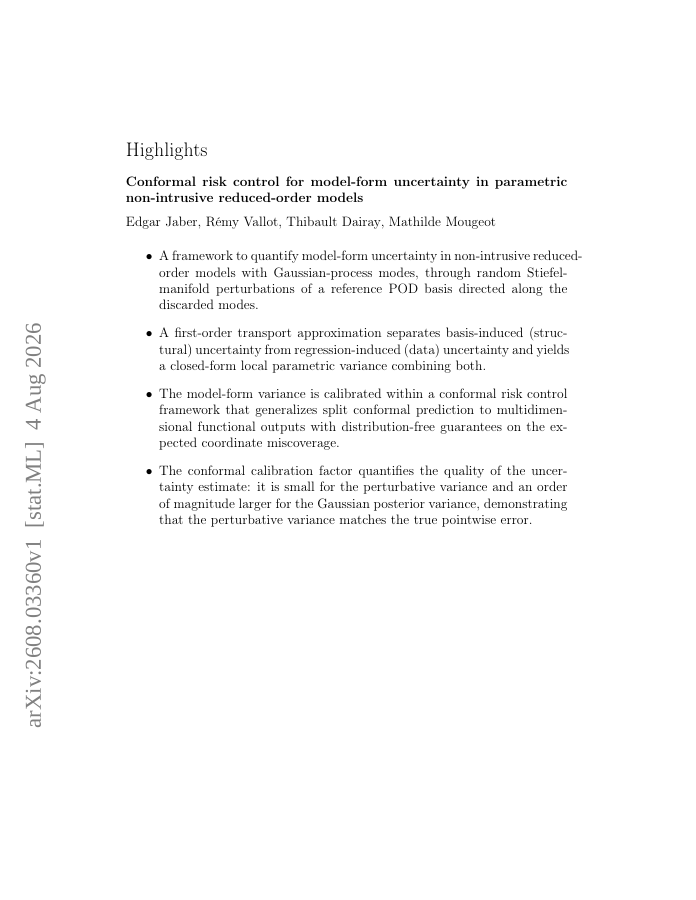
Non-intrusive reduced-order models (NIROMs) have become a standard tool for approximating parametric partial differential equations from computer design of experiments while significantly reducing computational costs. However, assessing the reliability of their predictions remains a major challenge, particularly in extrapolation regimes or under limited training data. In this work, we introduce a framework for quantifying model-form uncertainty in NIROMs by combining a perturbative stochastic representation of reduced bases with distribution-free conformal-type methods. Starting from a deterministic reduced basis constructed from snapshot matrices, we model uncertainty through random perturbations defined on the Stiefel manifold, directed along the discarded modes, yielding stochastic reduced-order approximations whose induced variance reflects the basis-truncation error. A transport approximation gives a closed-form posterior variance that sepa- rates basis-induced from regression-induced uncertainty, without re-training the underlying Gaussian processes. We include this posterior variance within a conformal risk control calibration framework, that provides prediction sets with coordinate miscoverage guarantees. The calibration factor produced by this framework is itself an interpretable, scalar diagnostic of the quality of the uncertainty estimate. The methodology is evaluated on parametric PDE benchmarks and an industrial tire-manufacturing calendering process. Numerical experiments demonstrate reliable, locally informative uncertainty quantification that goes beyond the Gaussian predictive variance.
Conformal risk control for model-form uncertainty in parametric non-intrusive reduced-order models
Non-intrusive reduced-order models (NIROMs) have become a standard tool for approximating parametric partial differential equations from computer design of experiments while significantly reducing computational costs.
- Preview
- Year
- 2026
- Hosting
- Abstract onlyARXIV-DEFAULT
Cite
Notes
Only stored in your browser.
Attribution
- Abstract & full text
- arxiv.org/abs/2608.03360ARXIV-DEFAULT
- TL;DR
- Semantic Scholar