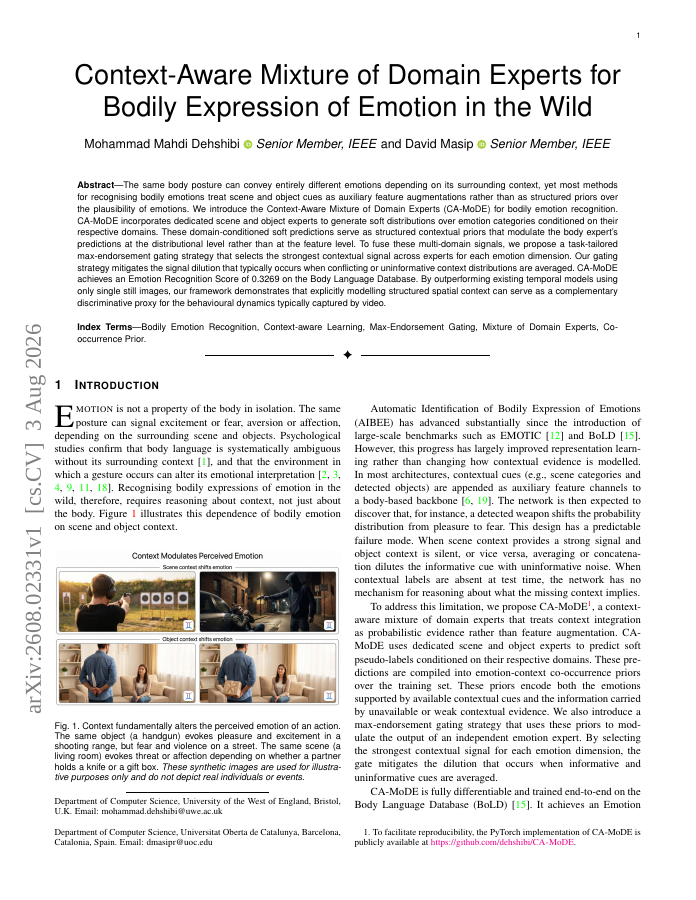
The same body posture can convey entirely different emotions depending on its surrounding context, yet most methods for recognising bodily emotions treat scene and object cues as auxiliary feature augmentations rather than as structured priors over the plausibility of emotions. We introduce the Context-Aware Mixture of Domain Experts (CA-MoDE) for bodily emotion recognition. CA-MoDE incorporates dedicated scene and object experts to generate soft distributions over emotion categories conditioned on their respective domains. These domain-conditioned soft predictions serve as structured contextual priors that modulate the body expert's predictions at the distributional level rather than at the feature level. To fuse these multi-domain signals, we propose a task-tailored max-endorsement gating strategy that selects the strongest contextual signal across experts for each emotion dimension. Our gating strategy mitigates the signal dilution that typically occurs when conflicting or uninformative context distributions are averaged. CA-MoDE achieves an Emotion Recognition Score of 0.3269 on the Body Language Database. By outperforming existing temporal models using only single still images, our framework demonstrates that explicitly modelling structured spatial context can serve as a complementary discriminative proxy for the behavioural dynamics typically captured by video.
Context-Aware Mixture of Domain Experts for Bodily Expression of Emotion in the Wild
The same body posture can convey entirely different emotions depending on its surrounding context, yet most methods for recognising bodily emotions treat scene and object cues as auxiliary feature augmentations rather than as structured priors over the plausibility of emotions.
- Preview
- Year
- 2026
- Hosting
- Excerpt onlyCC-BY-NC-SA-4.0
Cite
Notes
Only stored in your browser.
Attribution
- Abstract & full text
- arxiv.org/abs/2608.02331CC-BY-NC-SA-4.0
- TL;DR
- Semantic Scholar