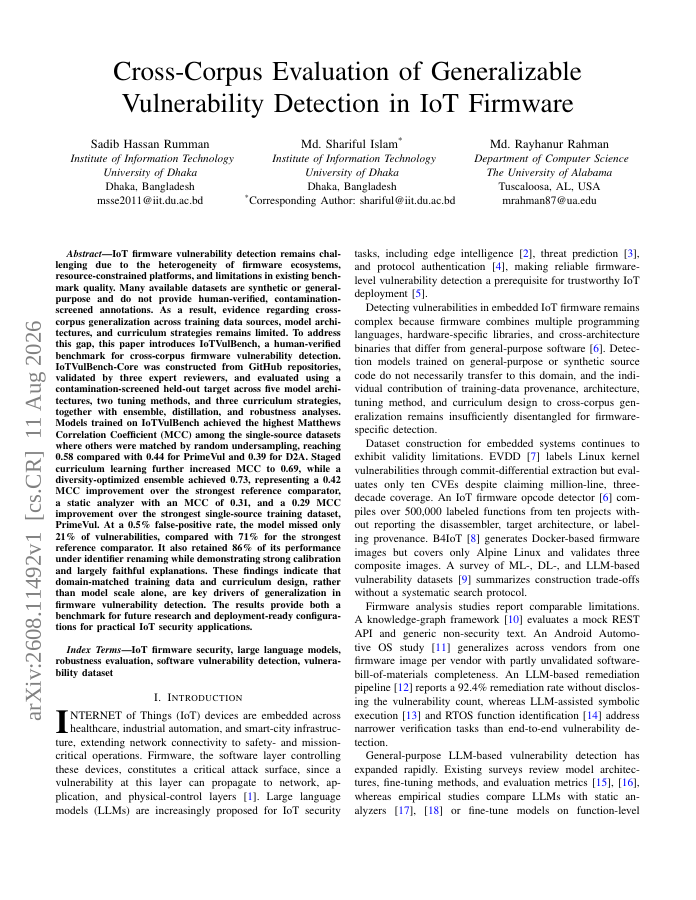
IoT firmware vulnerability detection is constrained by ecosystem heterogeneity, resource-limited platforms, and benchmark quality limitations. Existing datasets are often synthetic or general-purpose and lack human-verified, contamination-screened annotations, leaving cross-corpus generalization across training sources, architectures, and curriculum design underexplored. In this study, we have introduced IoTVulBench, a human-verified benchmark for cross-corpus firmware vulnerability detection. IoTVulBench was built from GitHub repositories, validated by three expert reviewers, and evaluated on a contamination-screened held-out target across five architectures, two tuning methods, and three curriculum strategies, with ensemble, distillation, and robustness analyses. Models trained on IoTVulBench reached the highest Matthews Correlation Coefficient (MCC) among undersampling-matched single-source datasets, at 0.58 versus 0.44 for PrimeVul and 0.39 for D2A. Staged curriculum learning raised MCC to 0.69, and a diversity-optimized ensemble reached 0.73. This gain represents a 0.42 MCC improvement over the strongest reference comparator, a static analyzer with an MCC of 0.31, and a 0.29 MCC improvement over the strongest single-source dataset, PrimeVul. At a 0.5% false-positive rate, the model missed only 21% of vulnerabilities versus 71% for the comparator. The model also retained 86% of its performance under identifier renaming, with strong calibration. These results indicate that domain-matched training data and curriculum design, rather than model scale alone, drive generalization in firmware vulnerability detection, and yield both a benchmark and deployment-ready configurations for IoT security.
Cross-Corpus Evaluation of Generalizable Vulnerability Detection in IoT Firmware
IoT firmware vulnerability detection is constrained by ecosystem heterogeneity, resource-limited platforms, and benchmark quality limitations. Existing datasets are often synthetic or general-purpose and lack human-verified, contamination-screened annotations, leaving…
- Preview
- Year
- 2026
- Hosting
- Abstract onlyARXIV-DEFAULT
Cite
Notes
Only stored in your browser.
Attribution
- Abstract & full text
- arxiv.org/abs/2608.11492ARXIV-DEFAULT
- TL;DR
- Semantic Scholar