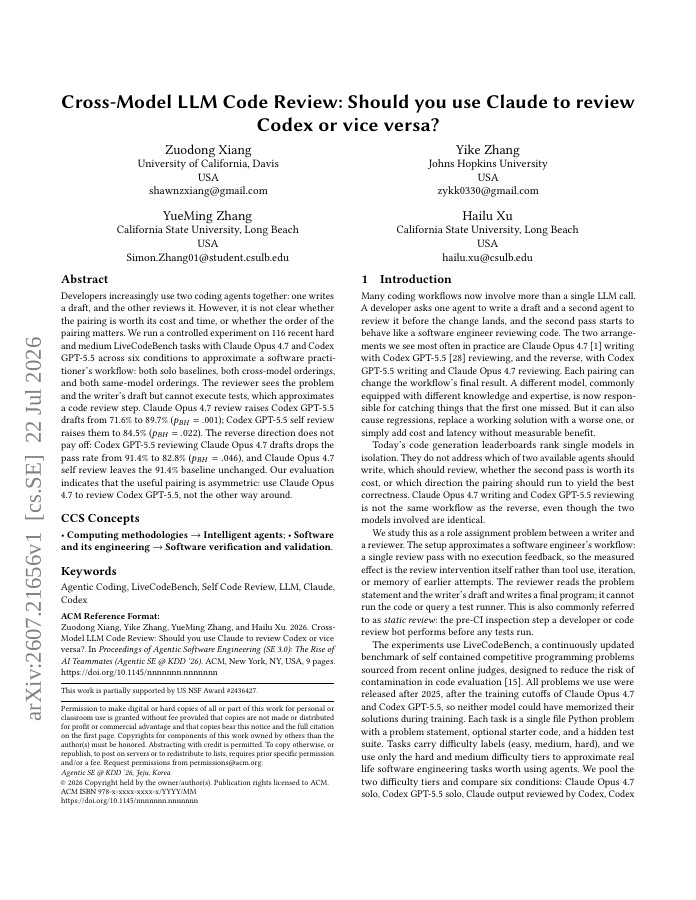
Developers increasingly use two coding agents together: one writes a draft, and the other reviews it. However, it is not clear whether the pairing is worth its cost and time, or whether the order of the pairing matters. We run a controlled experiment on 116 recent hard and medium lcb tasks with Claude and Codex across six conditions to approximate a software practitioner's workflow: both solo baselines, both cross-model orderings, and both same-model orderings. The reviewer sees the problem and the writer's draft but cannot execute tests, which approximates a code review step. Claude review raises Codex drafts from 71.6% to 89.7% (p_{BH}=.001); Codex self review raises them to 84.5% (p_{BH}=.022). The reverse direction does not pay off: Codex reviewing Claude drafts drops the pass rate from 91.4% to 82.8% (p_{BH}=.046), and Claude self review leaves the 91.4% baseline unchanged. Our evaluation indicates that the useful pairing is asymmetric: use Claude to review Codex, not the other way around.
Cross-Model LLM Code Review: Should you use Claude to review Codex or vice versa?
Developers increasingly use two coding agents together: one writes a draft, and the other reviews it. However, it is not clear whether the pairing is worth its cost and time, or whether the order of the pairing matters.
- Preview
- Year
- 2026
- Hosting
- Abstract onlyARXIV-DEFAULT
Cite
Notes
Only stored in your browser.
Attribution
- Abstract & full text
- arxiv.org/abs/2607.21656ARXIV-DEFAULT
- TL;DR
- Semantic Scholar