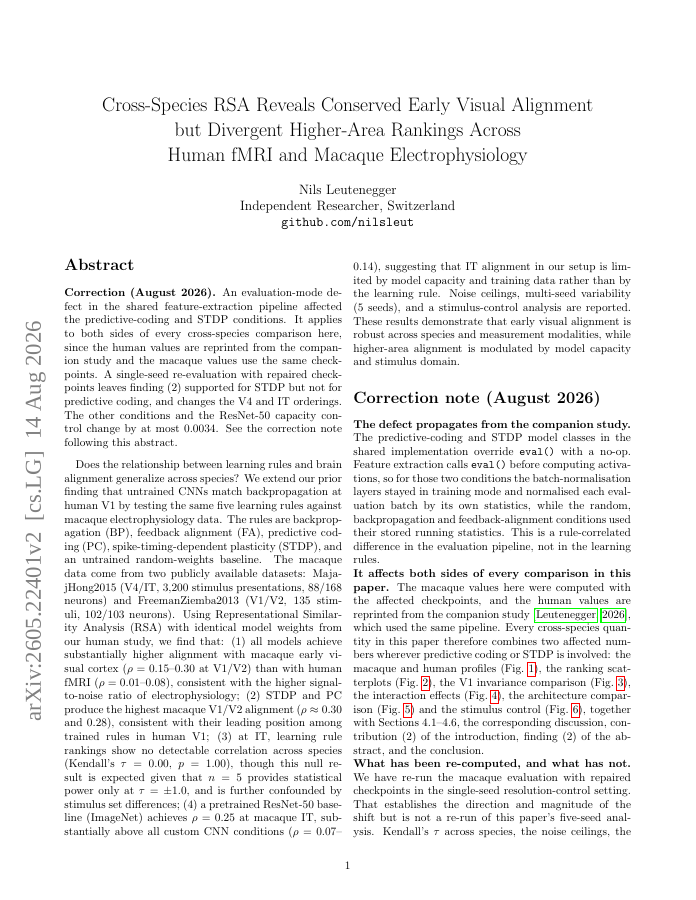
CORRECTION (August 2026): an evaluation-mode defect in the shared feature-extraction pipeline affected the predictive-coding and STDP conditions. It applies to both sides of every comparison here: the human values are reprinted from the companion study and the macaque values use the same checkpoints. In a single-seed re-evaluation with repaired checkpoints, macaque STDP at V1 moves from 0.305 to 0.266 and PC from 0.210 to 0.178, level with the untrained baseline, so finding (2) holds for STDP but not for PC; the V4 and IT orderings also change, while V2 is unchanged. Findings (1), (3) and (4) are unaffected, and the other conditions change by at most 0.0034. The five-seed analysis, Kendall's tau, noise ceilings and stimulus control have not been re-computed. See the correction note on page 1; the original abstract below is unchanged from v1. Follow-up study: arXiv:2608.12408. Does the relationship between learning rules and brain alignment generalize across species? We test the same five learning rules against macaque electrophysiology. The macaque data come from MajajHong2015 (V4/IT, 3,200 presentations, 88/168 neurons) and FreemanZiemba2013 (V1/V2, 135 stimuli, 102/103 neurons). Using RSA with identical model weights from our human study, we find: (1) all models achieve higher alignment with macaque early visual cortex (rho = 0.15-0.30 at V1/V2) than with human fMRI (rho = 0.01-0.08); (2) STDP and PC produce the highest macaque V1/V2 alignment; (3) at IT, rankings show no detectable correlation across species (Kendall's tau = 0.00), though this null is expected given that n = 5 provides power only at tau = +/-1.0; (4) a pretrained ResNet-50 achieves rho = 0.25 at macaque IT, substantially above all custom CNN conditions (rho = 0.07-0.14), suggesting IT alignment is limited by model capacity rather than by the learning rule.
Cross-Species RSA Reveals Conserved Early Visual Alignment but Divergent Higher-Area Rankings Across Human fMRI and Macaque Electrophysiology
CORRECTION (August 2026): an evaluation-mode defect in the shared feature-extraction pipeline affected the predictive-coding and STDP conditions. It applies to both sides of every comparison here: the human values are reprinted from the companion study and the macaque values use…
- Preview
- Year
- 2026
- Hosting
- Full text hostedCC-BY-4.0
Cite
Notes
Only stored in your browser.
Attribution
- Abstract & full text
- arxiv.org/abs/2605.22401CC-BY-4.0
- TL;DR
- Semantic Scholar