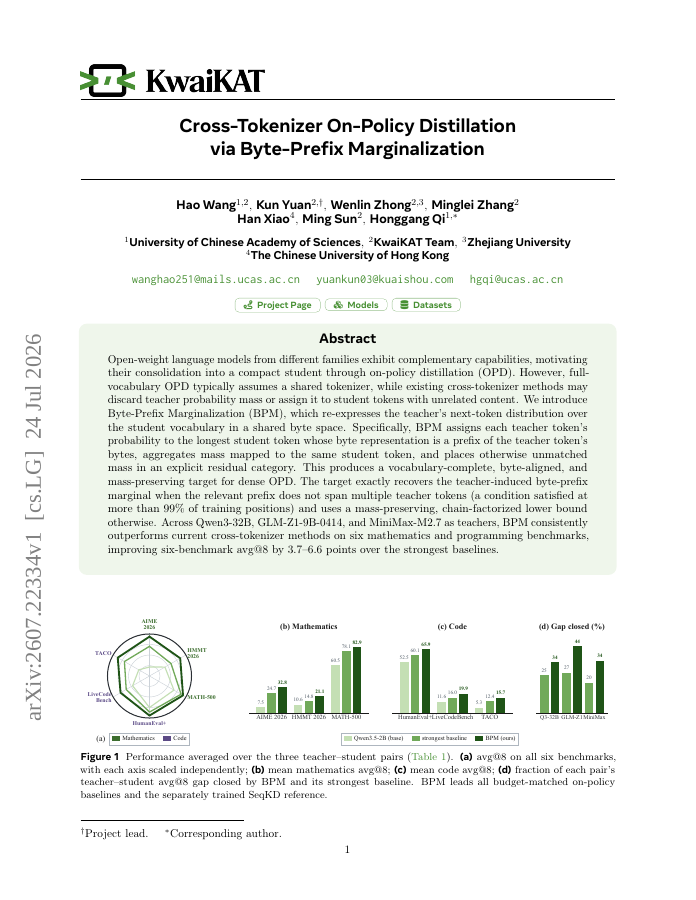
Open-weight language models from different families exhibit complementary capabilities, motivating their consolidation into a compact student through on-policy distillation (OPD). However, full-vocabulary OPD typically assumes a shared tokenizer, while existing cross-tokenizer methods may discard teacher probability mass or assign it to student tokens with unrelated content. We introduce Byte-Prefix Marginalization (BPM), which re-expresses the teacher's next-token distribution over the student vocabulary in a shared byte space. Specifically, BPM assigns each teacher token's probability to the longest student token whose byte representation is a prefix of the teacher token's bytes, aggregates mass mapped to the same student token, and places otherwise unmatched mass in an explicit residual category. This produces a vocabulary-complete, byte-aligned, and mass-preserving target for dense OPD. The target exactly recovers the teacher-induced byte-prefix marginal when the relevant prefix does not span multiple teacher tokens (a condition satisfied at more than 99% of training positions) and uses a mass-preserving, chain-factorized lower bound otherwise. Across Qwen3-32B, GLM-Z1-9B-0414, and MiniMax-M2.7 as teachers, BPM consistently outperforms current cross-tokenizer methods on six mathematics and programming benchmarks, improving six-benchmark avg@8 by 3.7-6.6 points over the strongest baselines.
Cross-Tokenizer On-Policy Distillation via Byte-Prefix Marginalization
Open-weight language models from different families exhibit complementary capabilities, motivating their consolidation into a compact student through on-policy distillation (OPD).
- Preview
- Year
- 2026
- Hosting
- Full text hostedCC-BY-4.0
Cite
Notes
Only stored in your browser.
Attribution
- Abstract & full text
- arxiv.org/abs/2607.22334CC-BY-4.0
- TL;DR
- Semantic Scholar