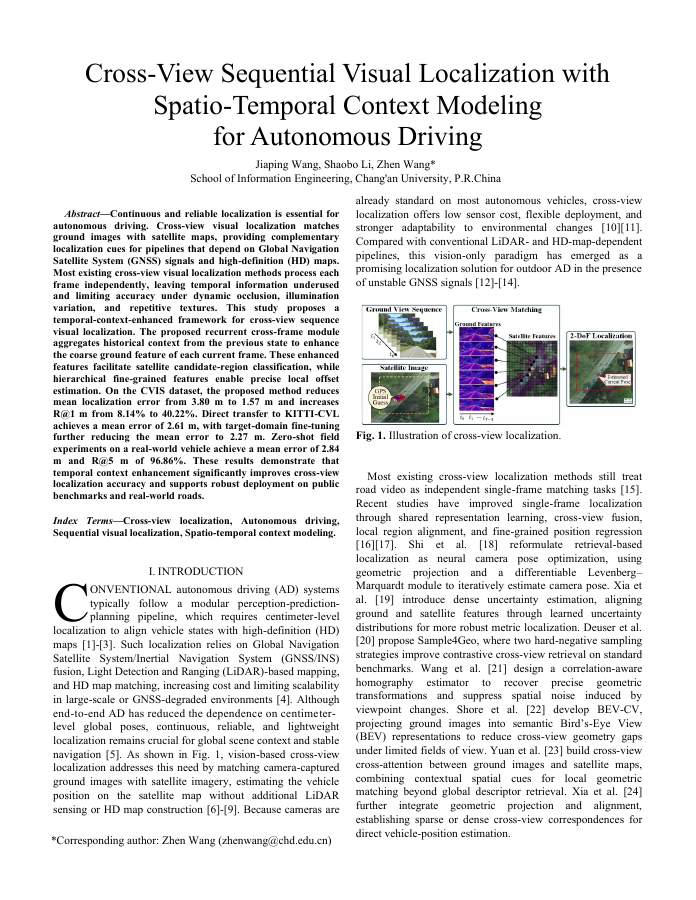
Continuous and reliable localization is essential for autonomous driving. Cross-view visual localization matches ground images with satellite maps, providing complementary localization cues for pipelines that depend on Global Navigation Satellite System (GNSS) signals and high-definition (HD) maps. Most existing cross-view visual localization methods process each frame independently, leaving temporal information underused and limiting accuracy under dynamic occlusion, illumination variation, and repetitive textures. This study proposes a temporal-context-enhanced framework for cross-view sequence visual localization. The proposed recurrent cross-frame module aggregates historical context from the previous state to enhance the coarse ground feature of each current frame. These enhanced features facilitate satellite candidate-region classification, while hierarchical fine-grained features enable precise local offset estimation. On the CVIS dataset, the proposed method reduces mean localization error from 3.80 m to 1.57 m and increases R@1 m from 8.14% to 40.22%. Direct transfer to KITTI-CVL achieves a mean error of 2.61 m, with target-domain fine-tuning further reducing the mean error to 2.27 m. Zero-shot field experiments on a real-world vehicle achieve a mean error of 2.84 m and R@5 m of 96.86%. These results demonstrate that temporal context enhancement significantly improves cross-view localization accuracy and supports robust deployment on public benchmarks and real-world roads.
Cross-View Sequential Visual Localization with Spatio-Temporal Context Modeling for Autonomous Driving
Continuous and reliable localization is essential for autonomous driving. Cross-view visual localization matches ground images with satellite maps, providing complementary localization cues for pipelines that depend on Global Navigation Satellite System (GNSS) signals and…
- Preview
- Year
- 2026
- Hosting
- Abstract onlyARXIV-DEFAULT
Cite
Notes
Only stored in your browser.
Attribution
- Abstract & full text
- arxiv.org/abs/2608.10660ARXIV-DEFAULT
- TL;DR
- Semantic Scholar