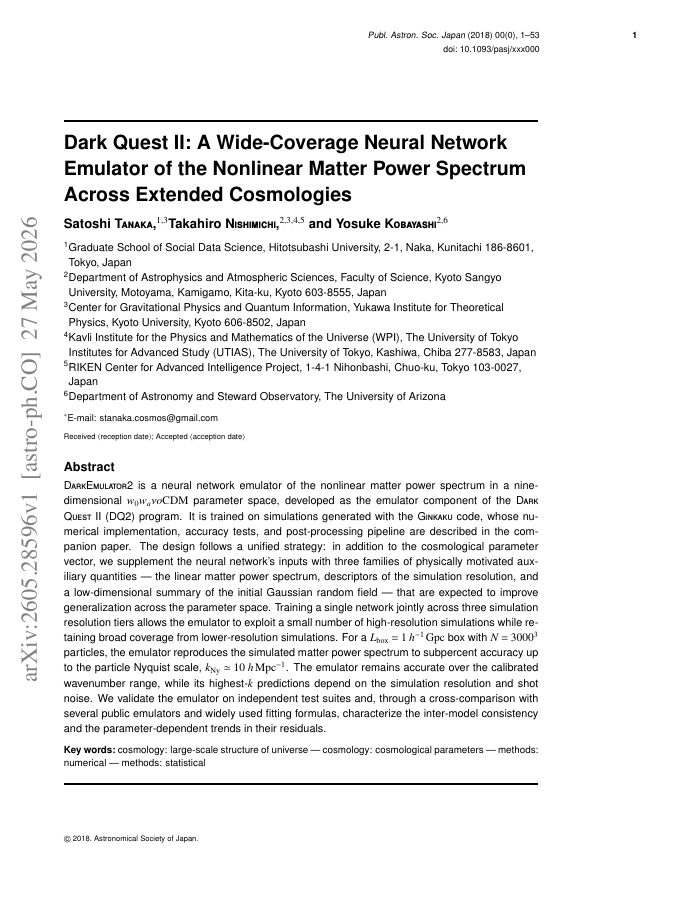
DarkEmulator2 is a neural network emulator of the nonlinear matter power spectrum in a nine-dimensional w_0 w_a νo CDM parameter space, developed as the emulator component of the Dark Quest II (DQ2) program. It is trained on simulations generated with the Ginkaku code, whose numerical implementation, accuracy tests, and post-processing pipeline are described in the companion paper. The design follows a unified strategy: in addition to the cosmological parameter vector, we supplement the neural network's inputs with three families of physically motivated auxiliary quantities -- the linear matter power spectrum, descriptors of the simulation resolution, and a low-dimensional summary of the initial Gaussian random field -- that are expected to improve generalization across the parameter space. Training a single network jointly across three simulation resolution tiers allows the emulator to exploit a small number of high-resolution simulations while retaining broad coverage from lower-resolution simulations. For a L_{box}=1,\hiGpc box with N=3000^{3} particles, the emulator reproduces the simulated matter power spectrum to subpercent accuracy up to the particle Nyquist scale, k_{Ny}\simeq 10,\hMpci. The emulator remains accurate over the calibrated wavenumber range, while its highest-k predictions depend on the simulation resolution and shot noise. We validate the emulator on independent test suites and, through a cross-comparison with several public emulators and widely used fitting formulas, characterize the inter-model consistency and the parameter-dependent trends in their residuals.
Dark Quest II: A Wide-Coverage Neural Network Emulator of the Nonlinear Matter Power Spectrum Across Extended Cosmologies
\textsc{DarkEmulator2} is a neural network emulator of the nonlinear matter power spectrum in a nine-dimensional $w_0 w_a νo \mathrm{CDM}$ parameter space, developed as the emulator component of the \textsc{Dark Quest II} (DQ2) program.
- Preview
- Year
- 2026
- Hosting
- Abstract onlyARXIV-DEFAULT
Cite
Notes
Only stored in your browser.
Attribution
- Abstract & full text
- arxiv.org/abs/2605.28596ARXIV-DEFAULT
- TL;DR
- Semantic Scholar