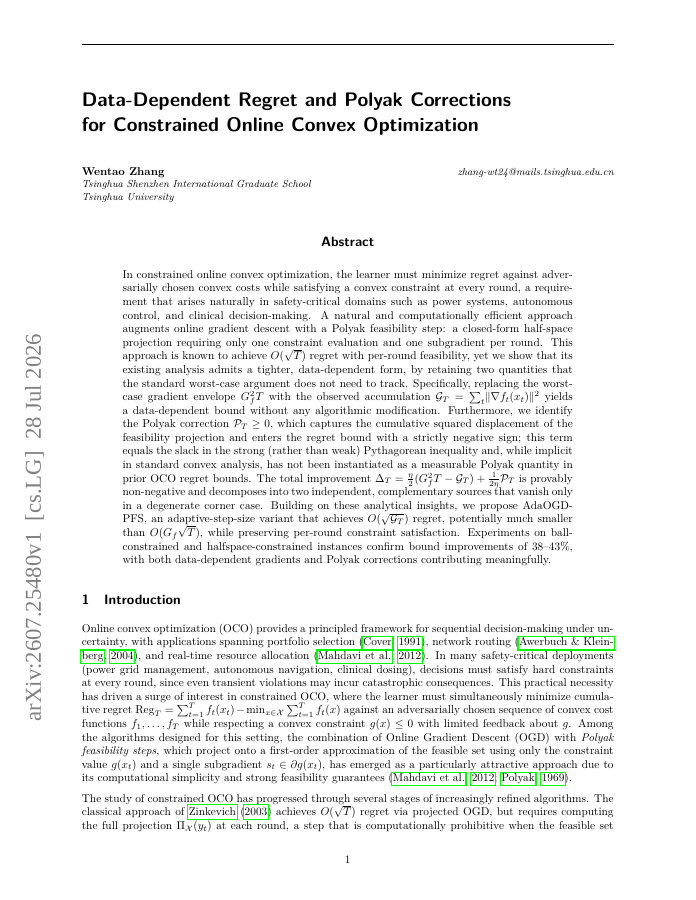
Constrained online convex optimization requires minimizing regret against adversarial convex costs while satisfying a convex constraint at every round, as needed in safety-critical applications. A computationally efficient method combines online gradient descent with a Polyak feasibility step, using one constraint evaluation and one subgradient per round. Although this method achieves O(sqrt(T)) regret with per-round feasibility, we derive a tighter, data-dependent analysis by retaining two quantities omitted by the standard worst-case argument. First, we replace the gradient envelope G_f^2 T with the observed accumulation G_T = sum_t ||grad f_t(x_t)||^2. Second, we identify a nonnegative Polyak correction P_T that measures the cumulative squared displacement caused by feasibility projections and enters the regret bound with a negative sign. The resulting improvement, Delta_T = (eta/2)(G_f^2 T - G_T) + P_T/(2 eta), is always nonnegative. We further propose AdaOGD-PFS, an adaptive-step-size method that achieves O(sqrt(G_T)) regret while preserving per-round feasibility. Experiments on ball- and halfspace-constrained problems improve the regret bound by 38 to 43 percent, with both data-dependent gradients and Polyak corrections contributing substantially.
Data-Dependent Regret and Polyak Corrections for Constrained Online Convex Optimization
Constrained online convex optimization requires minimizing regret against adversarial convex costs while satisfying a convex constraint at every round, as needed in safety-critical applications.
- Preview
- Year
- 2026
- Hosting
- Full text hostedCC-BY-4.0
Cite
Notes
Only stored in your browser.
Attribution
- Abstract & full text
- arxiv.org/abs/2607.25480CC-BY-4.0
- TL;DR
- Semantic Scholar