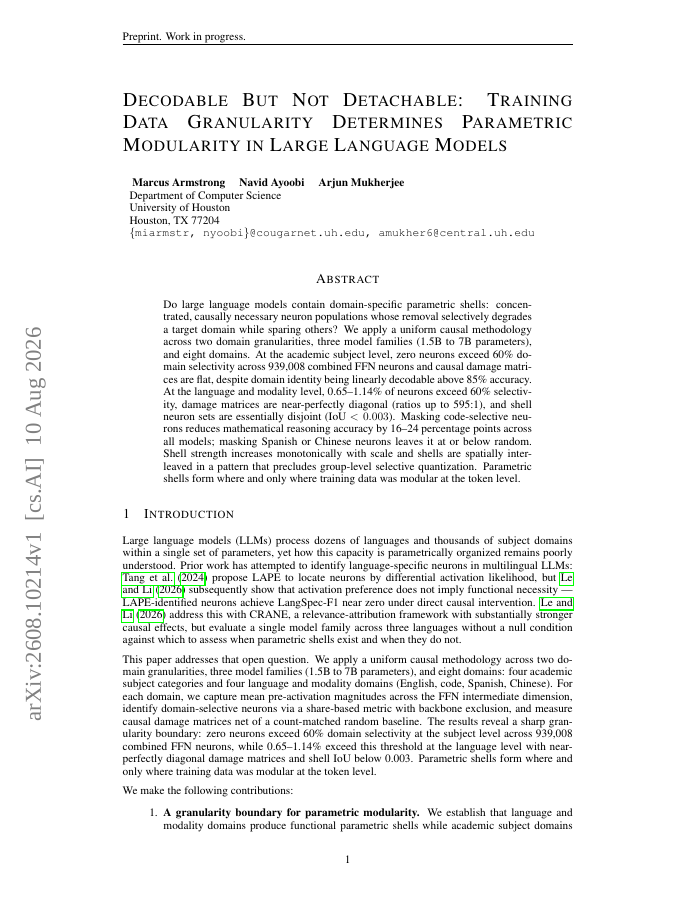
Do large language models contain domain-specific parametric shells: concentrated, causally necessary neuron populations whose removal selectively degrades a target domain while sparing others? We apply a uniform causal methodology across two domain granularities, three model families (1.5B to 7B parameters), and eight domains. At the academic subject level, zero neurons exceed 60% domain selectivity across 939,008 combined FFN neurons and causal damage matrices are flat, despite domain identity being linearly decodable above 85% accuracy. At the language and modality level, 0.65--1.14% of neurons exceed 60% selectivity, damage matrices are near-perfectly diagonal (ratios up to 595:1), and shell neuron sets are essentially disjoint (IoU < 0.003). Masking code-selective neurons reduces mathematical reasoning accuracy by 16--24 percentage points across all models; masking Spanish or Chinese neurons leaves it at or below random. Shell strength increases monotonically with scale and shells are spatially interleaved in a pattern that precludes group-level selective quantization. Parametric shells form where and only where training data was modular at the token level.
Decodable But Not Detachable: Training Data Granularity Determines Parametric Modularity in Large Language Models
Do large language models contain domain-specific parametric shells: concentrated, causally necessary neuron populations whose removal selectively degrades a target domain while sparing others? We apply a uniform causal methodology across two domain granularities, three model…
- Preview
- Year
- 2026
- Hosting
- Abstract onlyARXIV-DEFAULT
Cite
Notes
Only stored in your browser.
Attribution
- Abstract & full text
- arxiv.org/abs/2608.10214ARXIV-DEFAULT
- TL;DR
- Semantic Scholar