Abstractive summarization models remain vulnerable to factual inconsistency, redundancy, and weak length control. We propose a modular generation-and-selection framework for sentence-budget-constrained summarization. A pretrained generator produces multiple candidate summaries, which are decomposed into sentence-level candidates. A combinatorial selector then constructs the final summary by balancing relevance, factuality, and redundancy under an explicit budget. The framework supports MMR, ILP, and a DPP-inspired log-determinant objective without retraining the generator. Experiments on CNN/DailyMail, Multi-News, FaithBench, and TofuEval show consistent improvements in factuality and source-grounding metrics, especially for multi-document summarization, at the cost of lower reference-overlap scores. Human evaluation further indicates higher perceived consistency, relevance, clarity, and conciseness, with a small reduction in coherence. These results show that decoupling generation from selection provides a model-agnostic mechanism for improving factual grounding. Code is available at https://anonymous.4open.science/r/bcfs-D05E/.
Decoupling Generation and Selection for Budget-Constrained Faithful Summarization
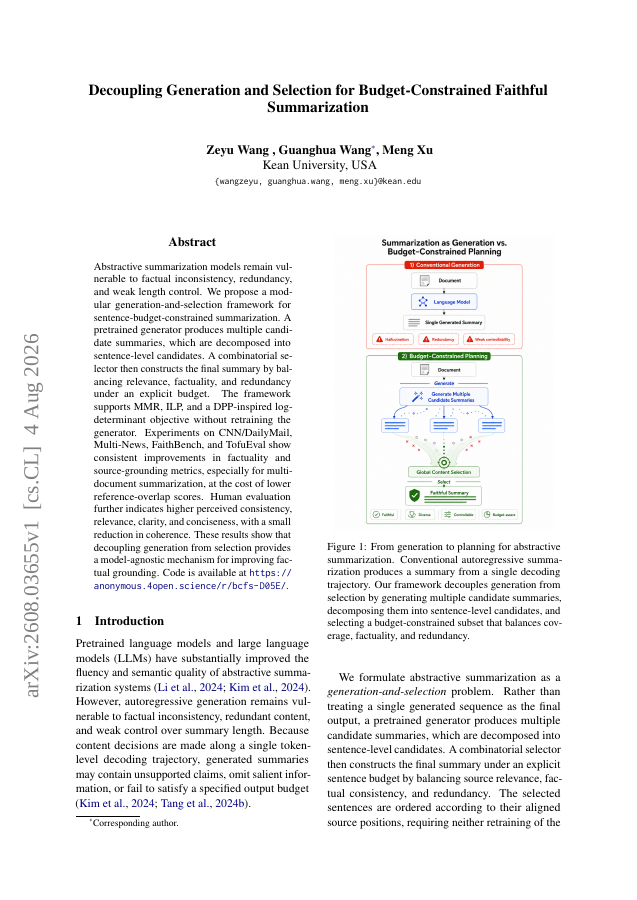
Abstractive summarization models remain vulnerable to factual inconsistency, redundancy, and weak length control. We propose a modular generation-and-selection framework for sentence-budget-constrained summarization.
- Preview
- Year
- 2026
- Hosting
- Abstract onlyARXIV-DEFAULT
Cite
Notes
Only stored in your browser.
Attribution
- Abstract & full text
- arxiv.org/abs/2608.03655ARXIV-DEFAULT
- TL;DR
- Semantic Scholar