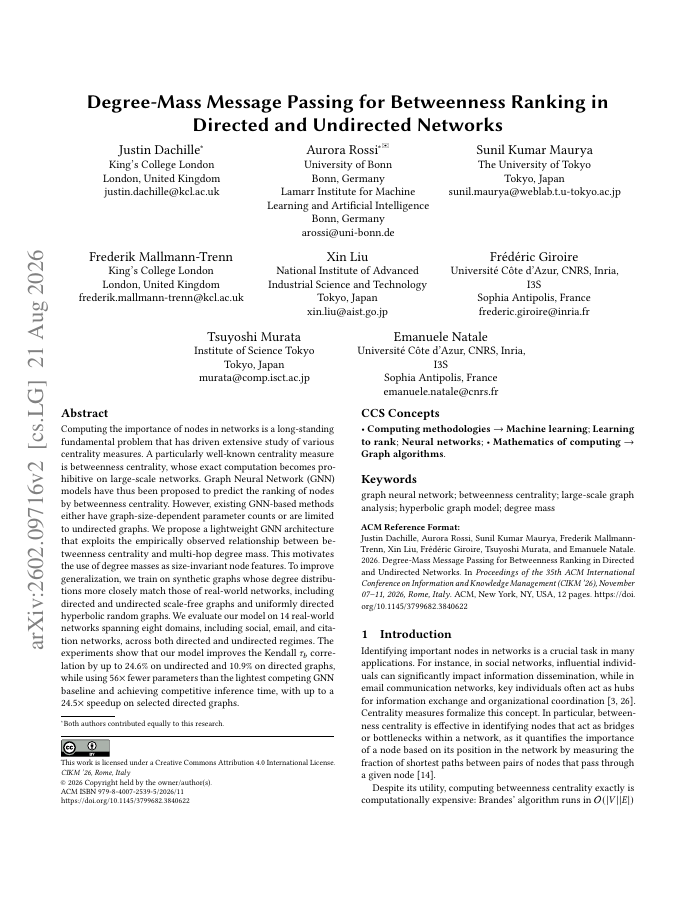
Computing the importance of nodes in networks is a long-standing fundamental problem that has driven extensive study of various centrality measures. A particularly well-known centrality measure is betweenness centrality, whose exact computation becomes prohibitive on large-scale networks. Graph Neural Network (GNN) models have thus been proposed to predict the ranking of nodes by betweenness centrality. However, existing GNN-based methods either have graph-size-dependent parameter counts or are limited to undirected graphs. We propose a lightweight GNN architecture that exploits the empirically observed relationship between betweenness centrality and multi-hop degree mass. This motivates the use of degree masses as size-invariant node features. To improve generalization, we train on synthetic graphs whose degree distributions more closely match those of real-world networks, including directed and undirected scale-free graphs and uniformly directed hyperbolic random graphs. We evaluate our model on 14 real-world networks spanning eight domains, including social, email, and citation networks, across both directed and undirected regimes. The experiments show that our model improves the Kendall τ_b correlation by up to 24.6% on undirected and 10.9% on directed graphs, while using 56\times fewer parameters than the lightest competing GNN baseline and achieving competitive inference time, with up to a 24.5\times speedup on selected directed graphs.
Degree-Mass Message Passing for Betweenness Ranking in Directed and Undirected Networks
Computing the importance of nodes in networks is a long-standing fundamental problem that has driven extensive study of various centrality measures. A particularly well-known centrality measure is betweenness centrality, whose exact computation becomes prohibitive on large-scale…
- Preview
- Year
- 2026
- Hosting
- Full text hostedCC-BY-4.0
Cite
Notes
Only stored in your browser.
Attribution
- Abstract & full text
- arxiv.org/abs/2602.09716CC-BY-4.0
- TL;DR
- Semantic Scholar