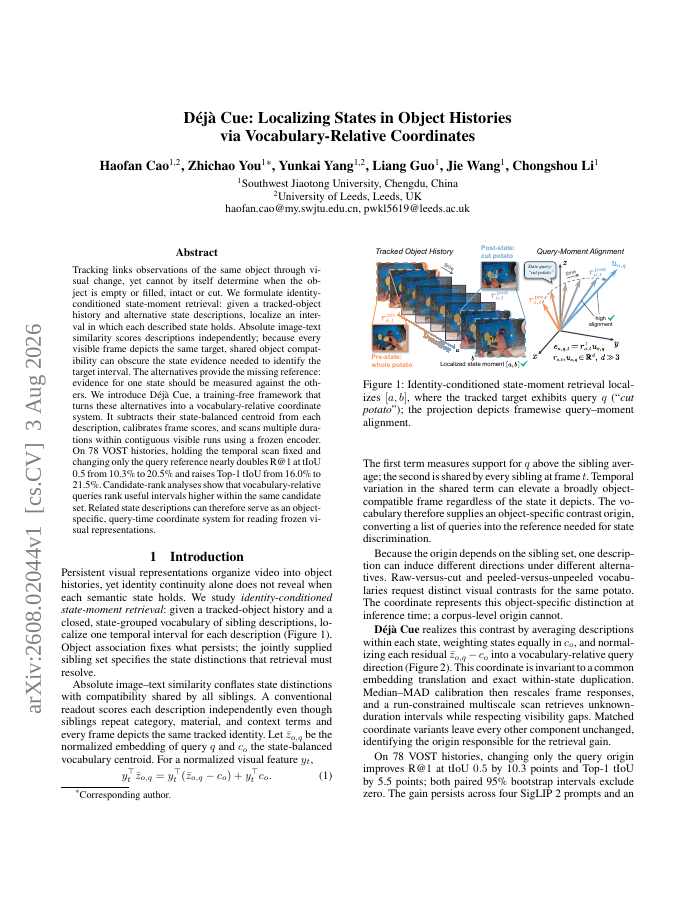
Tracking links observations of the same object through visual change, yet cannot by itself determine when the object is empty or filled, intact or cut. We formulate identity-conditioned state-moment retrieval: given a tracked-object history and alternative state descriptions, localize an interval in which each described state holds. Absolute image-text similarity scores descriptions independently; because every visible frame depicts the same target, shared object compatibility can obscure the state evidence needed to identify the target interval. The alternatives provide the missing reference: evidence for one state should be measured against the others. We introduce Déjà Cue, a training-free framework that turns these alternatives into a vocabulary-relative coordinate system. It subtracts their state-balanced centroid from each description, calibrates frame scores, and scans multiple durations within contiguous visible runs using a frozen encoder. On 78 VOST histories, holding the temporal scan fixed and changing only the query reference nearly doubles R@1 at tIoU 0.5 from 10.3% to 20.5% and raises Top-1 tIoU from 16.0% to 21.5%. Candidate-rank analyses show that vocabulary-relative queries rank useful intervals higher within the same candidate set. Related state descriptions can therefore serve as an object-specific, query-time coordinate system for reading frozen visual representations.
Déjà Cue: Localizing States in Object Histories via Vocabulary-Relative Coordinates
Tracking links observations of the same object through visual change, yet cannot by itself determine when the object is empty or filled, intact or cut. We formulate identity-conditioned state-moment retrieval: given a tracked-object history and alternative state descriptions,…
- Preview
- Year
- 2026
- Hosting
- Abstract onlyARXIV-DEFAULT
Cite
Notes
Only stored in your browser.
Attribution
- Abstract & full text
- arxiv.org/abs/2608.02044ARXIV-DEFAULT
- TL;DR
- Semantic Scholar