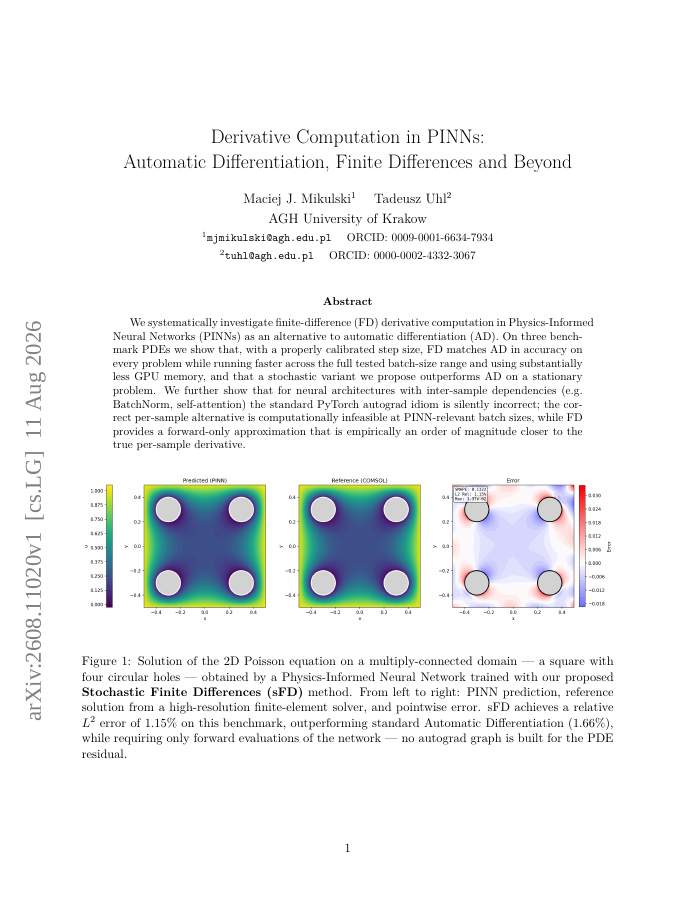
We systematically investigate finite-difference (FD) derivative computation in Physics-Informed Neural Networks (PINNs) as an alternative to automatic differentiation (AD). On three benchmark PDEs we show that, with a properly calibrated step size, FD matches AD in accuracy on every problem while running faster across the full tested batch-size range and using substantially less GPU memory, and that a stochastic variant we propose outperforms AD on a stationary problem. We further show that for neural architectures with inter-sample dependencies (e.g. BatchNorm, self-attention) the standard PyTorch autograd idiom is silently incorrect; the correct per-sample alternative is computationally infeasible at PINN-relevant batch sizes, while FD provides a forward-only approximation that is empirically an order of magnitude closer to the true per-sample derivative.
Derivative Computation in PINNs: Automatic Differentiation, Finite Differences and Beyond
We systematically investigate finite-difference (FD) derivative computation in Physics-Informed Neural Networks (PINNs) as an alternative to automatic differentiation (AD).
- Preview
- Year
- 2026
- Hosting
- Abstract onlyARXIV-DEFAULT
Cite
Notes
Only stored in your browser.
Attribution
- Abstract & full text
- arxiv.org/abs/2608.11020ARXIV-DEFAULT
- TL;DR
- Semantic Scholar