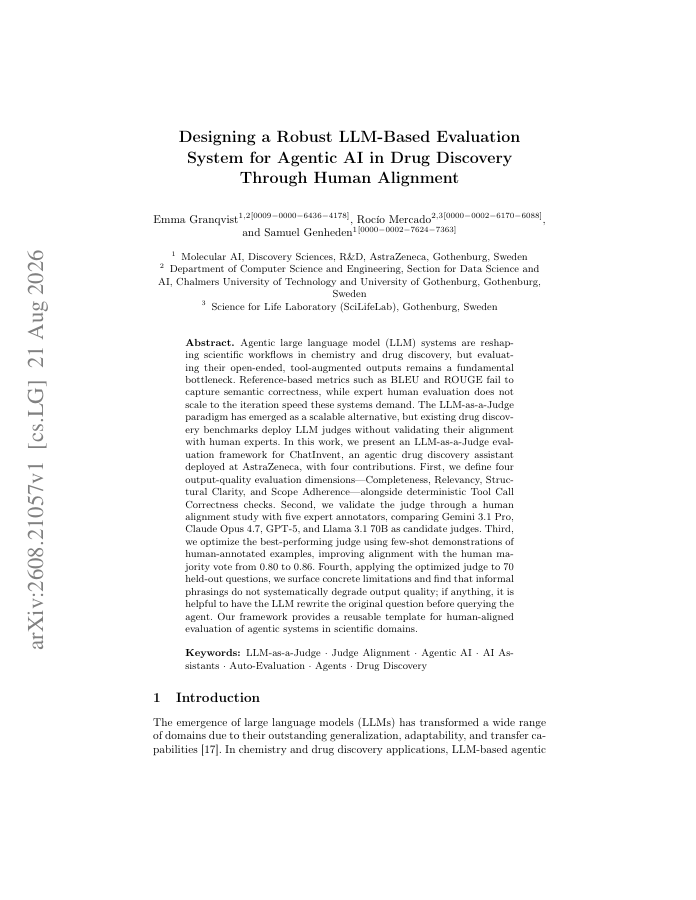
Agentic large language model (LLM) systems are reshaping scientific workflows in chemistry and drug discovery, but evaluating their open-ended, tool-augmented outputs remains a fundamental bottleneck. Reference-based metrics such as BLEU and ROUGE fail to capture semantic correctness, while expert human evaluation does not scale to the iteration speed these systems demand. The LLM-as-a-Judge paradigm has emerged as a scalable alternative, but existing drug discovery benchmarks deploy LLM judges without validating their alignment with human experts. In this work, we present an LLM-as-a-Judge evaluation framework for ChatInvent, an agentic drug discovery assistant deployed at AstraZeneca, with four contributions. First, we define four output-quality evaluation dimensions---Completeness, Relevancy, Structural Clarity, and Scope Adherence---alongside deterministic Tool Call Correctness checks. Second, we validate the judge through a human alignment study with five expert annotators, comparing Gemini 3.1 Pro, Claude Opus 4.7, GPT-5, and Llama 3.1 70B as candidate judges. Third, we optimize the best-performing judge using few-shot demonstrations of human-annotated examples, improving alignment with the human majority vote from 0.80 to 0.86. Fourth, applying the optimized judge to 70 held-out questions, we surface concrete limitations and find that informal phrasings do not systematically degrade output quality; if anything, it is helpful to have the LLM rewrite the original question before querying the agent. Our framework provides a reusable template for human-aligned evaluation of agentic systems in scientific domains.
Designing a Robust LLM-Based Evaluation System for Agentic AI in Drug Discovery Through Human Alignment
Agentic large language model (LLM) systems are reshaping scientific workflows in chemistry and drug discovery, but evaluating their open-ended, tool-augmented outputs remains a fundamental bottleneck.
- Preview
- Year
- 2026
- Hosting
- Full text hostedCC-BY-4.0
Cite
Notes
Only stored in your browser.
Attribution
- Abstract & full text
- arxiv.org/abs/2608.21057CC-BY-4.0
- TL;DR
- Semantic Scholar