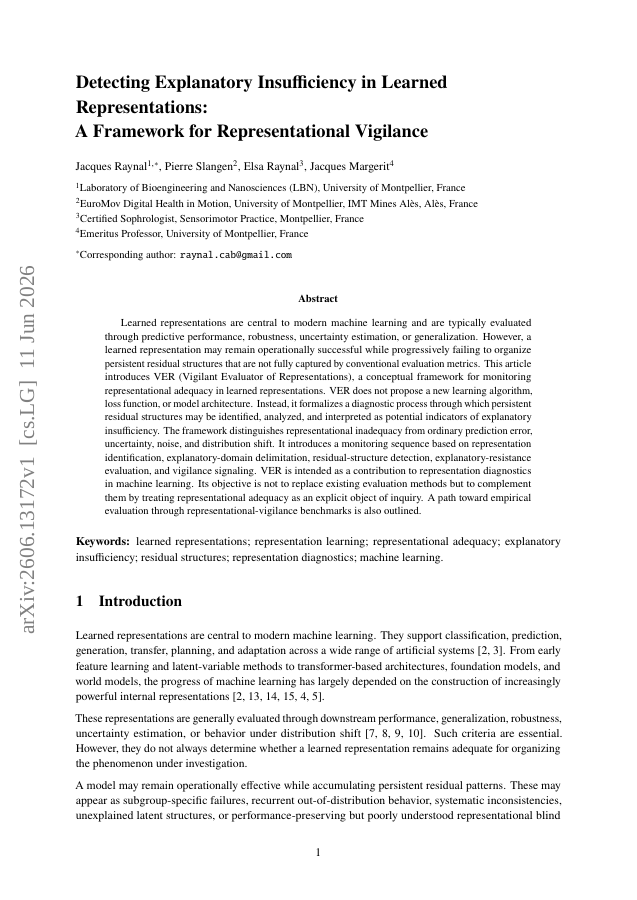
Learned representations are central to modern machine learning and are commonly evaluated through predictive performance, robustness, uncertainty estimation, and generalization. However, a representation may remain operationally successful while failing to organize persistent residual structures that conventional metrics do not fully capture. This article introduces VER, the Vigilant Evaluator of Representations, a conceptual framework for monitoring representational adequacy. VER does not propose a new learning algorithm, loss function, or model architecture. It defines a diagnostic process for identifying residual structures and assessing whether they may indicate explanatory insufficiency rather than ordinary error, uncertainty, noise, data limitation, or distribution shift. The framework comprises five operations: representation identification, explanatory-domain delimitation, residual-structure detection, explanatory-resistance evaluation, and vigilance signaling. VER distinguishes stable adequacy, a vigilance condition, and a representational alert. It is intended to complement performance evaluation, uncertainty estimation, out-of-distribution detection, robustness analysis, and explainable AI by making representational adequacy an explicit object of inquiry. The article also outlines a path toward empirical evaluation through benchmarks designed to detect representational inadequacy when predictive performance remains satisfactory. VER is conceptual and methodological; it does not prove that a representation is inadequate, select a replacement representation, or provide an operational implementation.
Detecting Explanatory Insufficiency in Learned Representations: A Framework for Representational Vigilance
Learned representations are central to modern machine learning and are commonly evaluated through predictive performance, robustness, uncertainty estimation, and generalization.
- Preview
- Year
- 2026
- Hosting
- Full text hostedCC-BY-4.0
Cite
Notes
Only stored in your browser.
Attribution
- Abstract & full text
- arxiv.org/abs/2606.13172CC-BY-4.0
- TL;DR
- Semantic Scholar