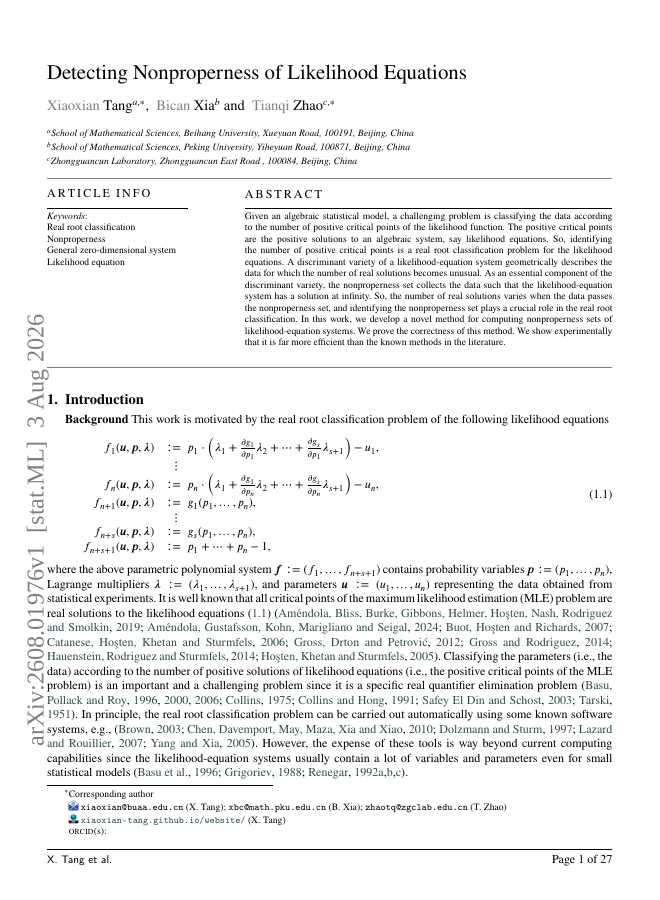
Given an algebraic statistical model, a challenging problem is classifying the data according to the number of positive critical points of the likelihood function. The positive critical points are the positive solutions to an algebraic system, say likelihood equations. So, identifying the number of positive critical points is a real root classification problem for the likelihood equations. A discriminant variety of a likelihood-equation system geometrically describes the data for which the number of real solutions becomes unusual. As an essential component of the discriminant variety, the nonproperness set collects the data such that the likelihood-equation system has a solution at infinity. So, the number of real solutions varies when the data passes the nonproperness set, and identifying the nonproperness set plays a crucial role in the real root classification. In this work, we develop a novel method for computing nonproperness sets of likelihood-equation systems. We prove the correctness of this method. We show experimentally that it is far more efficient than the known methods in the literature.
Detecting Nonproperness of Likelihood Equations
Given an algebraic statistical model, a challenging problem is classifying the data according to the number of positive critical points of the likelihood function. The positive critical points are the positive solutions to an algebraic system, say likelihood equations.
- Preview
- Year
- 2026
- Hosting
- Abstract onlyARXIV-DEFAULT
Cite
Notes
Only stored in your browser.
Attribution
- Abstract & full text
- arxiv.org/abs/2608.01976ARXIV-DEFAULT
- TL;DR
- Semantic Scholar