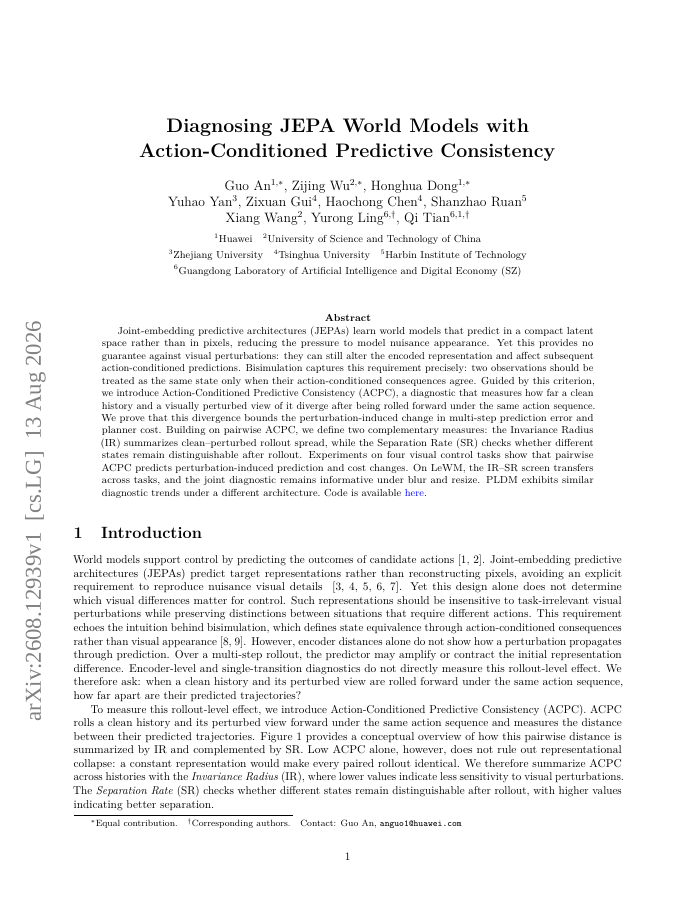
Joint-embedding predictive architectures (JEPAs) learn world models that predict in a compact latent space rather than in pixels, reducing the pressure to model nuisance appearance. Yet this provides no guarantee against visual perturbations: they can still alter the encoded representation and affect subsequent action-conditioned predictions. Bisimulation captures this requirement precisely: two observations should be treated as the same state only when their action-conditioned consequences agree. Guided by this criterion, we introduce Action-Conditioned Predictive Consistency (ACPC), a diagnostic that measures how far a clean history and a visually perturbed view of it diverge after being rolled forward under the same action sequence. We prove that this divergence bounds the perturbation-induced change in multi-step prediction error and planner cost. Building on pairwise ACPC, we define two complementary measures: the Invariance Radius (IR) summarizes clean-perturbed rollout spread, while the Separation Rate (SR) checks whether different states remain distinguishable after rollout. Experiments on four visual control tasks show that pairwise ACPC predicts perturbation-induced prediction and cost changes. On LeWM, the IR-SR screen transfers across tasks, and the joint diagnostic remains informative under blur and resize. PLDM exhibits similar diagnostic trends under a different architecture.
Diagnosing JEPA World Models with Action-Conditioned Predictive Consistency
Joint-embedding predictive architectures (JEPAs) learn world models that predict in a compact latent space rather than in pixels, reducing the pressure to model nuisance appearance.
- Preview
- Year
- 2026
- Hosting
- Full text hostedCC-BY-4.0
Cite
Notes
Only stored in your browser.
Attribution
- Abstract & full text
- arxiv.org/abs/2608.12939CC-BY-4.0
- TL;DR
- Semantic Scholar