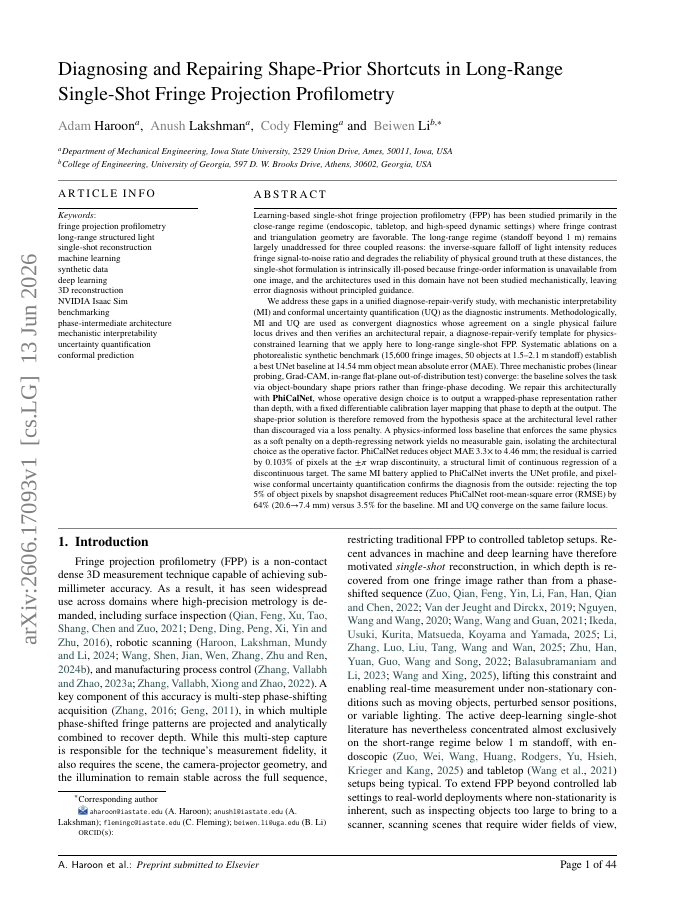
Learning-based single-shot fringe projection profilometry (FPP) has been studied almost entirely at close range, and the networks used are evaluated only on aggregate error, leaving open whether they recover depth from fringe phase or from object-level shape cues that correlate with depth. This paper diagnoses that question mechanistically in the long-range regime (standoff beyond 1 m). Using FPP-ML-Bench, an open photorealistic synthetic benchmark (15,600 fringe images, 50 objects at 1.5--2.1 m), we first formalize why the single-shot fringe-to-depth mapping is more severely ill-posed at long range: it is non-injective without fringe-order information, and the depth error from an incorrect fringe order grows as Z^2 in the working distance. Systematic ablations, extended with a multi-frame study, establish a best UNet baseline at 14.54 mm object mean absolute error (MAE), 18% of the 80 mm object depth range, with only a 1.9\times spread across four architectures, indicating a representational rather than a capacity-bound limit. A mechanistic interpretability study, the first applied to an FPP network, localizes the cause: linear probing shows edges are 2.82\times more decodable than depth, Grad-CAM shows attention favoring boundaries over fringes by 1.28\times, and an in-range flat-plane test collapses a featureless plane to background depth despite valid fringes. The baseline solves the task via object-boundary shape priors rather than fringe-phase decoding. Because the shortcut is a hypothesis-space property, additional data or larger models will not remove it, motivating an architectural repair that removes the shape-prior solution by construction.
Diagnosing Shape-Prior Shortcuts in Long-Range Single-Shot Fringe Projection Profilometry
Learning-based single-shot fringe projection profilometry (FPP) has been studied almost entirely at close range, and the networks used are evaluated only on aggregate error, leaving open whether they recover depth from fringe phase or from object-level shape cues that correlate…
- Preview
- Year
- 2026
- Hosting
- Full text hostedCC-BY-4.0
Cite
Notes
Only stored in your browser.
Attribution
- Abstract & full text
- arxiv.org/abs/2606.17093CC-BY-4.0
- TL;DR
- Semantic Scholar