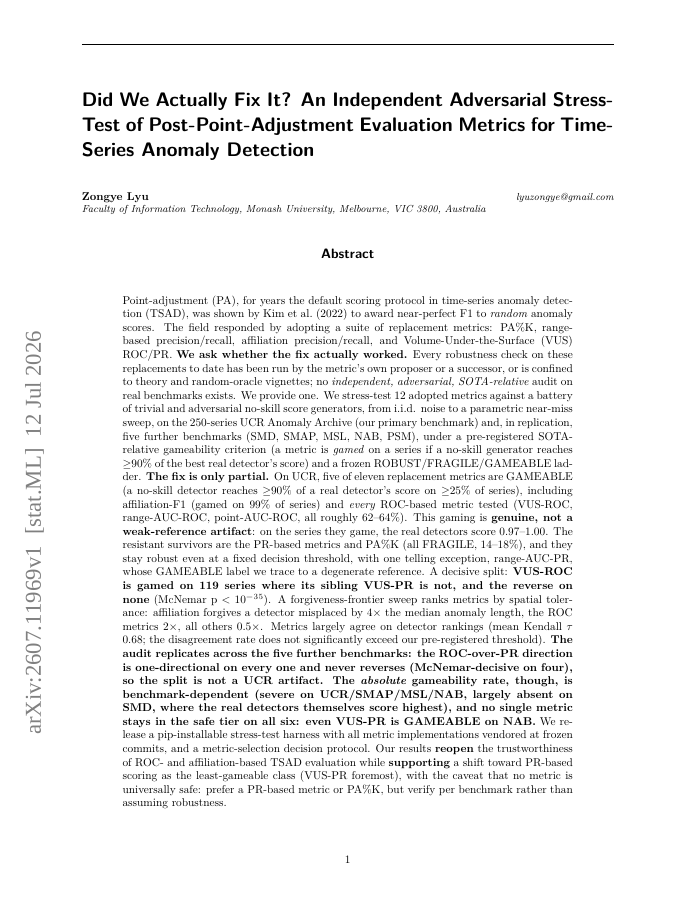
Point-adjustment (PA), for years the default scoring protocol in time-series anomaly detection (TSAD), was shown by Kim et al. (2022) to award near-perfect F1 to random anomaly scores. The field adopted a suite of replacement metrics (PA%K, range-based precision/recall, affiliation precision/recall, and Volume-Under-the-Surface, VUS, ROC/PR). We ask, independently and adversarially, whether these resist no-skill detectors on real benchmarks, and find the answer turns entirely on one overlooked variable: N, the number of random attempts an adversary reports the best of. Under a single honest run (N=1), not one replacement metric is gameable on any of six benchmarks (UCR, SMD, SMAP, MSL, NAB, PSM): a random detector reaches 90% of the best real detector's score on at most 11% of series for affiliation-F1, 5% for the ROC family, and 2% for the PR-based metrics and PA%K. But under best-of-N reporting, the seed-shopping endemic to ML, the metrics split sharply. affiliation-F1 and every ROC-based metric inflate steeply, affiliation crossing gameable (25% of series) by N=3 and reaching 0.98 at the full pool (N=41), the ROC family crossing by N=9-11; the PR-based metrics and PA%K stay near-flat at every N, floored near the anomaly prevalence (the lone exception is NAB at large N). A paired test finds VUS-ROC inflated on 131 series where its sibling VUS-PR is not, and never the reverse. The ROC-vs-PR split follows from the order-statistic behaviour of AUC under extreme class imbalance (a random PR-AUC is floored at prevalence); affiliation inflates by a second route, its extreme single-run leniency (already fragile at N=1). We release a pip-installable stress-test harness, and recommend reporting single-run scores or disclosing N and preferring PR-based metrics, which resist best-of-N inflation on nearly every benchmark.
Did We Actually Fix It? An Independent Adversarial Stress-Test of Post-Point-Adjustment Evaluation Metrics for Time-Series Anomaly Detection
Point-adjustment (PA), for years the default scoring protocol in time-series anomaly detection (TSAD), was shown by Kim et al. (2022) to award near-perfect F1 to random anomaly scores.
- Preview
- Year
- 2026
- Hosting
- Abstract onlyARXIV-DEFAULT
Cite
Notes
Only stored in your browser.
Attribution
- Abstract & full text
- arxiv.org/abs/2607.11969ARXIV-DEFAULT
- TL;DR
- Semantic Scholar