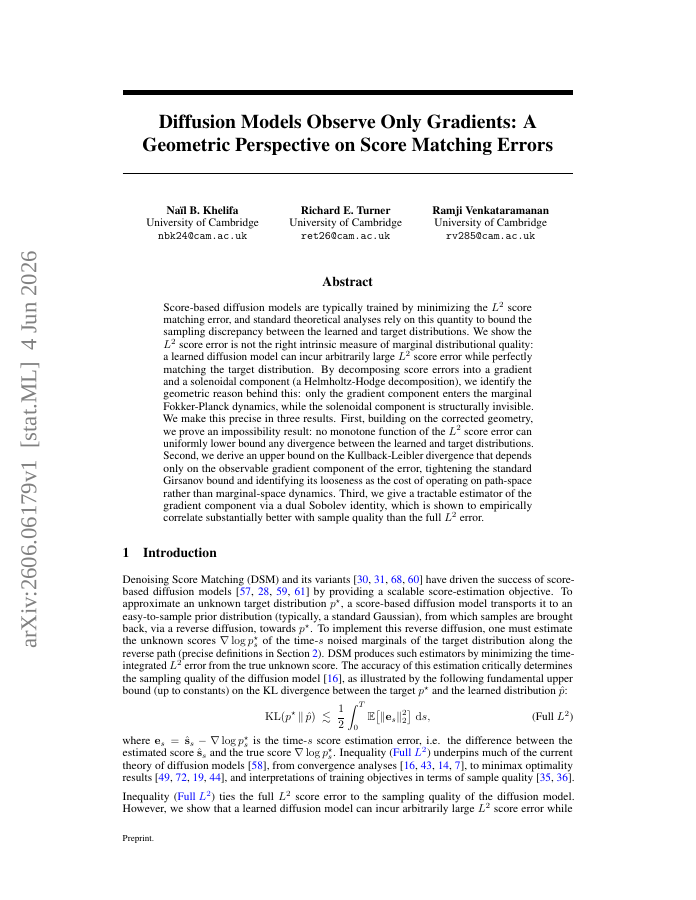
Score-based diffusion models are typically trained by minimizing the L^2 score matching error, and standard theoretical analyses rely on this quantity to bound the sampling discrepancy between the learned and target distributions. We show the L^2 score error is not the right intrinsic measure of marginal distributional quality: a learned diffusion model can incur arbitrarily large L^2 score error while perfectly matching the target distribution. By decomposing score errors into a gradient and a solenoidal component (a Helmholtz-Hodge decomposition), we identify the geometric reason behind this: only the gradient component enters the marginal Fokker-Planck dynamics, while the solenoidal component is structurally invisible. We make this precise in three results. First, building on the corrected geometry, we prove an impossibility result: no monotone function of the L^2 score error can uniformly lower bound any divergence between the learned and target distributions. Second, we derive an upper bound on the Kullback-Leibler divergence that depends only on the observable gradient component of the error, tightening the standard Girsanov bound for generic score networks, and identifying its looseness as the cost of operating on path-space rather than marginal-space dynamics. Third, we give a tractable estimator of the gradient component via a dual Sobolev identity, which is shown to empirically correlate substantially better with sample quality than the full L^2 error.
Diffusion Models Observe Only Gradients: A Geometric Perspective on Score Matching Errors
Score-based diffusion models are typically trained by minimizing the $L^2$ score matching error, and standard theoretical analyses rely on this quantity to bound the sampling discrepancy between the learned and target distributions.
- Preview
- Year
- 2026
- Hosting
- Full text hostedCC-BY-4.0
Cite
Notes
Only stored in your browser.
Attribution
- Abstract & full text
- arxiv.org/abs/2606.06179CC-BY-4.0
- TL;DR
- Semantic Scholar