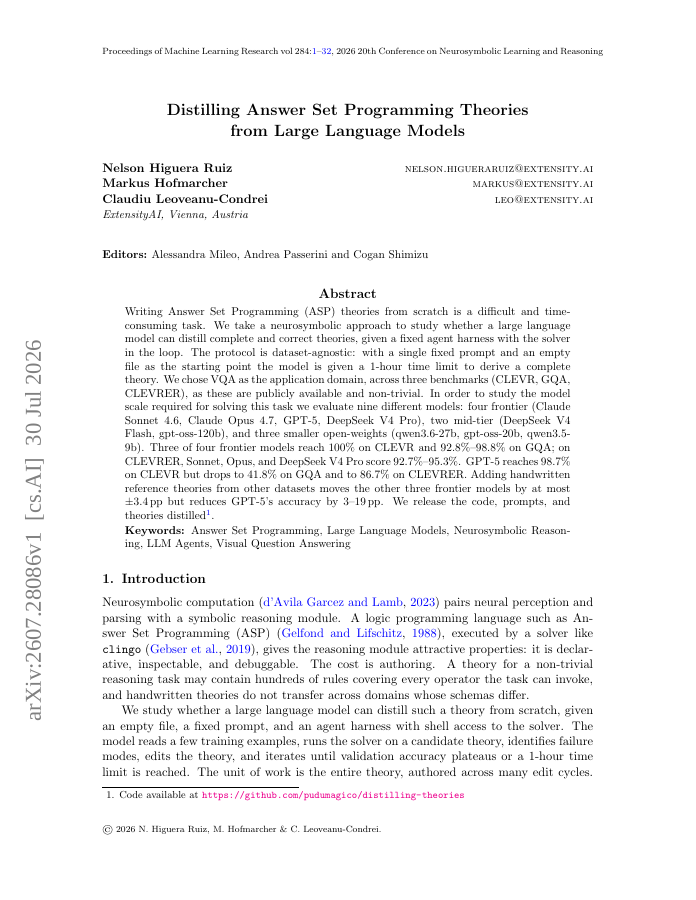
Writing Answer Set Programming (ASP) theories from scratch is a difficult and time-consuming task. We take a neurosymbolic approach to study whether a model can distill complete and correct theories, given a fixed agent harness with the solver in the loop. The protocol is dataset-agnostic: with a single prompt and an empty file as the starting point the model is given a 1-hour time limit to derive a complete theory. We chose VQA as the application domain, three benchmarks (CLEVR, GQA, CLEVRER), as these are publicly available and non-trivial. In order to study the model scale required for solving this task we nine different models: four frontier (Claude Sonnet 4.6, Claude Opus 4.7, GPT-5, DeepSeek V4 Pro), two mid-tier (DeepSeek V4 Flash, gpt-oss-120b), and three open-weights (qwen3.6-27b, gpt-oss-20b, qwen3.5-9b). Three of four frontier models reach 100% on CLEVR and 92.8%-98.8% on GQA; on CLEVRER, Sonnet, Opus, DeepSeek V4 Pro score 92.7%-95.3%. GPT-5 reaches 98.7% on CLEVR but drops to 41.8% on GQA and to 86.7% on CLEVRER. Adding handwritten reference theories from other datasets moves the other three frontier models by at most +/-3.4 pp but reduces GPT-5's accuracy by 3-19 pp. We release the code, prompts, and theories distilled.
Distilling Answer Set Programming Theories from Large Language Models
Writing Answer Set Programming (ASP) theories from scratch is a difficult and time-consuming task. We take a neurosymbolic approach to study whether a model can distill complete and correct theories, given a fixed agent harness with the solver in the loop.
- Preview
- Year
- 2026
- Hosting
- Full text hostedCC-BY-4.0
Cite
Notes
Only stored in your browser.
Attribution
- Abstract & full text
- arxiv.org/abs/2607.28086CC-BY-4.0
- TL;DR
- Semantic Scholar