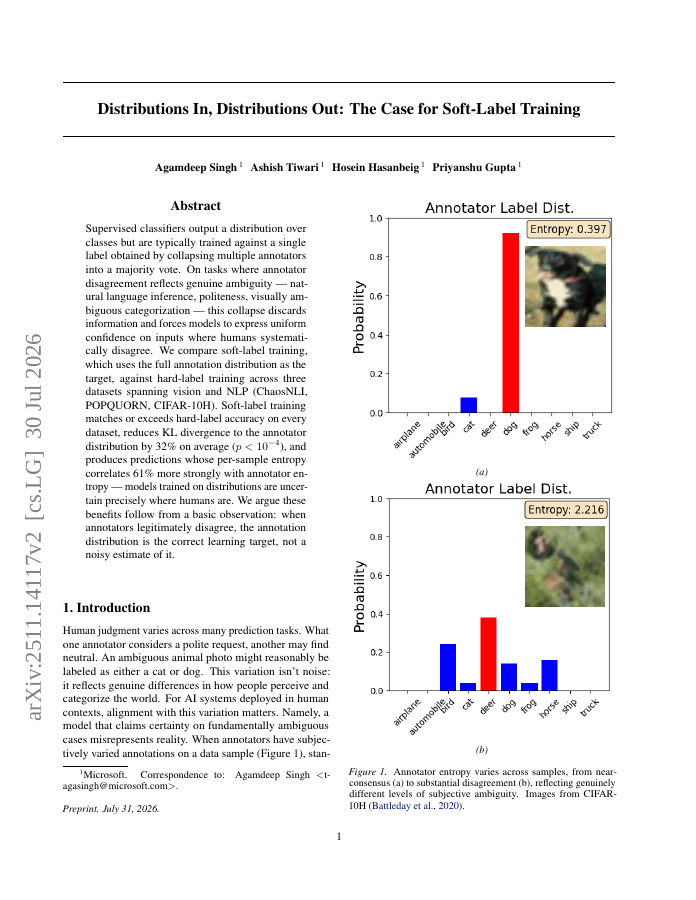
Supervised classifiers output a distribution over classes but are typically trained against a single label obtained by collapsing multiple annotators into a majority vote. On tasks where annotator disagreement reflects genuine ambiguity -- natural language inference, politeness, visually ambiguous categorization -- this collapse discards information and forces models to express uniform confidence on inputs where humans systematically disagree. We compare soft-label training, which uses the full annotation distribution as the target, against hard-label training across three datasets spanning vision and NLP (ChaosNLI, POPQUORN, CIFAR-10H). Soft-label training matches or exceeds hard-label accuracy on every dataset, reduces KL divergence to the annotator distribution by 32% on average (p < 10^-4), and produces predictions whose per-sample entropy correlates 61% more strongly with annotator entropy -- models trained on distributions are uncertain precisely where humans are. We argue these benefits follow from a basic observation: when annotators legitimately disagree, the annotation distribution is the correct learning target, not a noisy estimate of it.
Distributions In, Distributions Out: The Case for Soft-Label Training
Supervised classifiers output a distribution over classes but are typically trained against a single label obtained by collapsing multiple annotators into a majority vote.
- Preview
- Year
- 2025
- Hosting
- Full text hostedCC-BY-4.0
Cite
Notes
Only stored in your browser.
Attribution
- Abstract & full text
- arxiv.org/abs/2511.14117CC-BY-4.0
- TL;DR
- Semantic Scholar