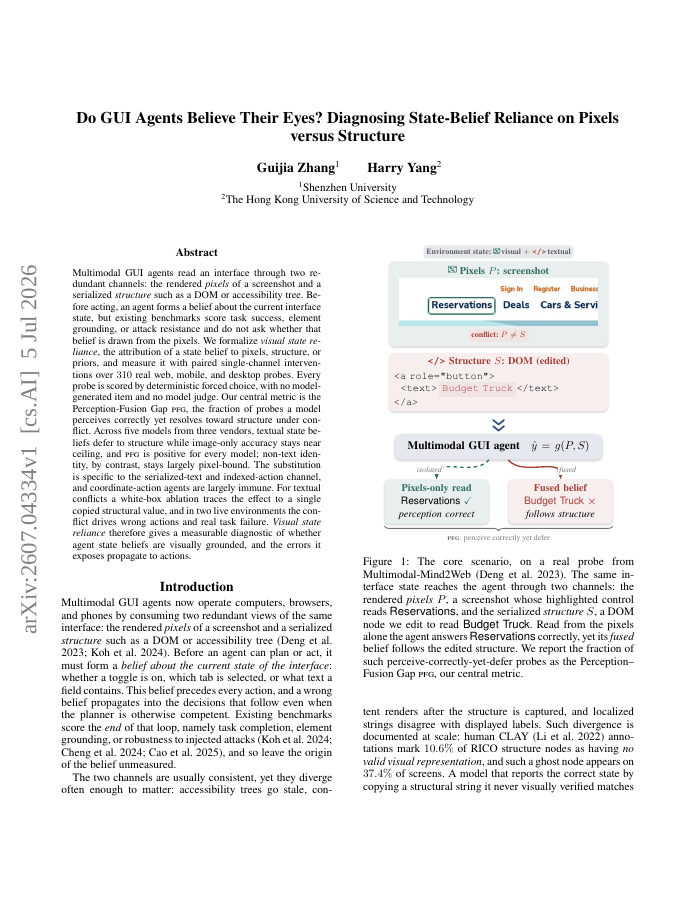
Multimodal GUI agents read an interface through two redundant channels: the rendered pixels of a screenshot and a serialized structure such as a document object model or accessibility tree. Before acting, an agent forms a belief about the current interface state, but existing benchmarks score task success, element grounding, or attack resistance and do not ask whether that belief is drawn from the pixels. We formalize visual state reliance, the attribution of a state belief to pixels, structure, or priors, and measure it with paired single-channel interventions over 735 probes spanning real web, mobile, and desktop interfaces, of which 225 are zero-edit divergences mined from live production websites, all scored by deterministic forced choice with no model judge. Our central metric is the Perception-Fusion Gap (PFG), the fraction of probes a model perceives correctly yet resolves toward structure under conflict; a stricter variant that re-verifies perception on a tight crop of the target region leaves the gap intact. Across models from four vendors, textual state beliefs defer to structure while image-only accuracy stays near ceiling, and on unedited stale snapshots from live pages the same models follow the outdated structure on up to 0.88 of probes. A white-box ablation traces the textual effect to a single copied structural value, and gradient attribution shows the visual evidence is processed yet overridden. In live multi-step environments, one mis-sourced belief at the first step compounds into task failure with a self-recovery rate of at most 0.03. Comparing four mitigations on identical probes, prompt-level cues fail at the action level, certificate checks buy safety with refusals, and a training-free consistency gate is alone in reducing both hijack and task error. Visual state reliance thus gives a measurable diagnostic of whether agent state beliefs are visually grounded.
Do GUI Agents Believe Their Eyes? Diagnosing State-Belief Reliance on Pixels versus Structure
Multimodal GUI agents read an interface through two redundant channels: the rendered pixels of a screenshot and a serialized structure such as a document object model or accessibility tree.
- Preview
- Year
- 2026
- Hosting
- Abstract onlyARXIV-DEFAULT
Cite
Notes
Only stored in your browser.
Attribution
- Abstract & full text
- arxiv.org/abs/2607.04334ARXIV-DEFAULT
- TL;DR
- Semantic Scholar