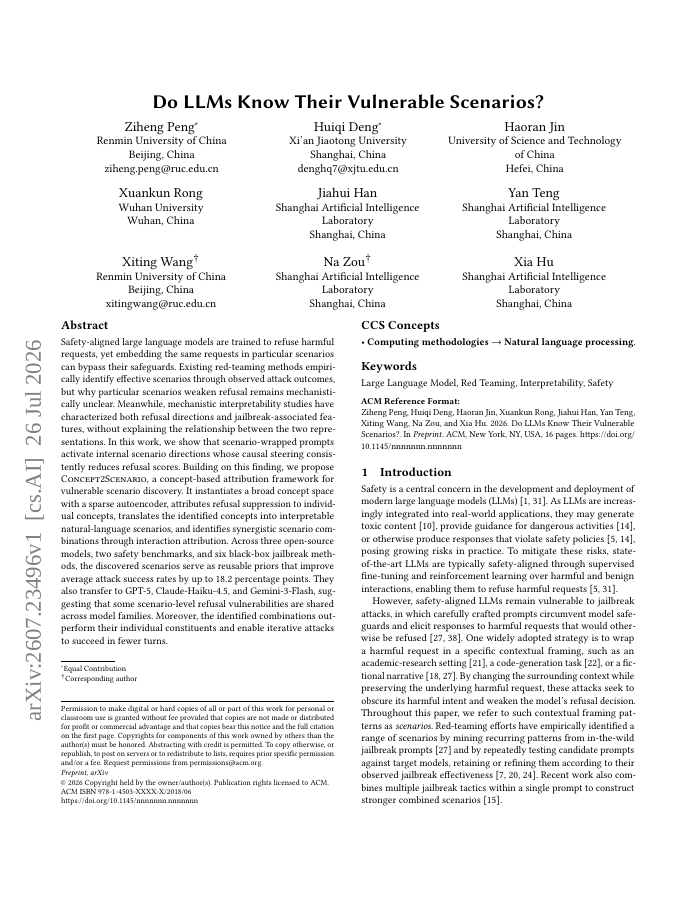
Safety-aligned large language models are trained to refuse harmful requests, yet embedding the same requests in particular scenarios can bypass their safeguards. Existing red-teaming methods empirically identify effective scenarios through observed attack outcomes, but why particular scenarios weaken refusal remains mechanistically unclear. Meanwhile, mechanistic interpretability studies have characterized both refusal directions and jailbreak-associated features, without explaining the relationship between the two representations. In this work, we show that scenario-wrapped prompts activate internal scenario directions whose causal steering consistently reduces refusal scores. Building on this finding, we propose Concept2Scenario, a concept-based attribution framework for vulnerable scenario discovery. It instantiates a broad concept space with a sparse autoencoder, attributes refusal suppression to individual concepts, translates the identified concepts into interpretable natural-language scenarios, and identifies synergistic scenario combinations through interaction attribution. Across three open-source models, two safety benchmarks, and six black-box jailbreak methods, the discovered scenarios serve as reusable priors that improve average attack success rates by up to 18.2 percentage points. They also transfer to GPT-5, Claude-Haiku-4.5, and Gemini-3-Flash, suggesting that some scenario-level refusal vulnerabilities are shared across model families. Moreover, the identified combinations outperform their individual constituents and enable iterative attacks to succeed in fewer turns.
Do LLMs Know Their Vulnerable Scenarios?
Safety-aligned large language models are trained to refuse harmful requests, yet embedding the same requests in particular scenarios can bypass their safeguards. Existing red-teaming methods empirically identify effective scenarios through observed attack outcomes, but why…
- Preview
- Year
- 2026
- Hosting
- Full text hostedCC-BY-4.0
Cite
Notes
Only stored in your browser.
Attribution
- Abstract & full text
- arxiv.org/abs/2607.23496CC-BY-4.0
- TL;DR
- Semantic Scholar