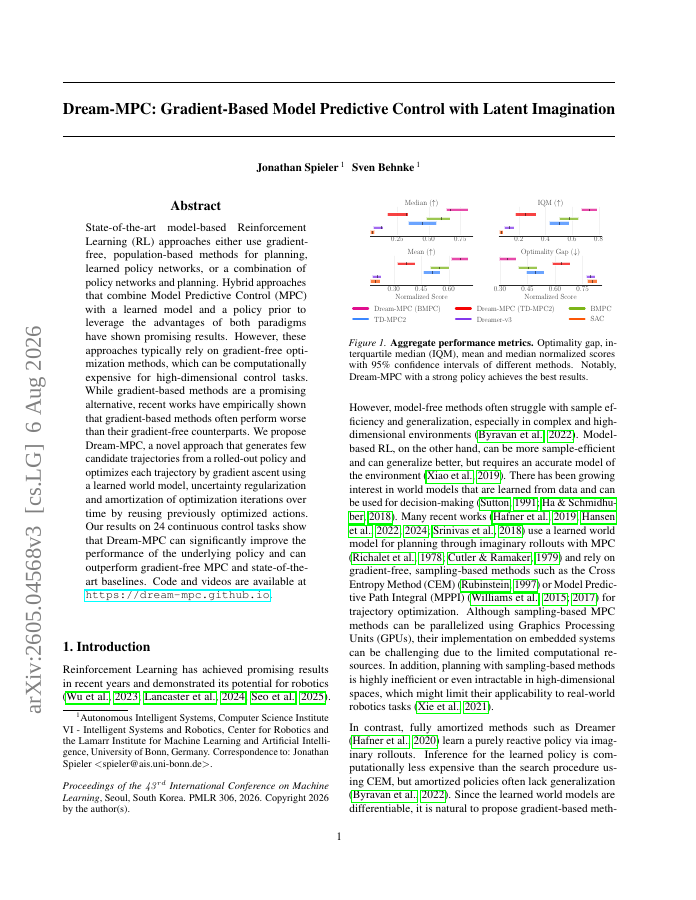
State-of-the-art model-based Reinforcement Learning (RL) approaches either use gradient-free, population-based methods for planning, learned policy networks, or a combination of policy networks and planning. Hybrid approaches that combine Model Predictive Control (MPC) with a learned model and a policy prior to leverage the advantages of both paradigms have shown promising results. However, these approaches typically rely on gradient-free optimization methods, which can be computationally expensive for high-dimensional control tasks. While gradient-based methods are a promising alternative, recent works have empirically shown that gradient-based methods often perform worse than their gradient-free counterparts. We propose Dream-MPC, a novel approach that generates few candidate trajectories from a rolled-out policy and optimizes each trajectory by gradient ascent using a learned world model, uncertainty regularization and amortization of optimization iterations over time by reusing previously optimized actions. Our results on 24 continuous control tasks show that Dream-MPC can significantly improve the performance of the underlying policy and can outperform gradient-free MPC and state-of-the-art baselines. Code and videos are available at https://dream-mpc.github.io.
Dream-MPC: Gradient-Based Model Predictive Control with Latent Imagination
State-of-the-art model-based Reinforcement Learning (RL) approaches either use gradient-free, population-based methods for planning, learned policy networks, or a combination of policy networks and planning.
- Preview
- Year
- 2026
- Hosting
- Full text hostedCC-BY-SA-4.0
Cite
Notes
Only stored in your browser.
Attribution
- Abstract & full text
- arxiv.org/abs/2605.04568CC-BY-SA-4.0
- TL;DR
- Semantic Scholar