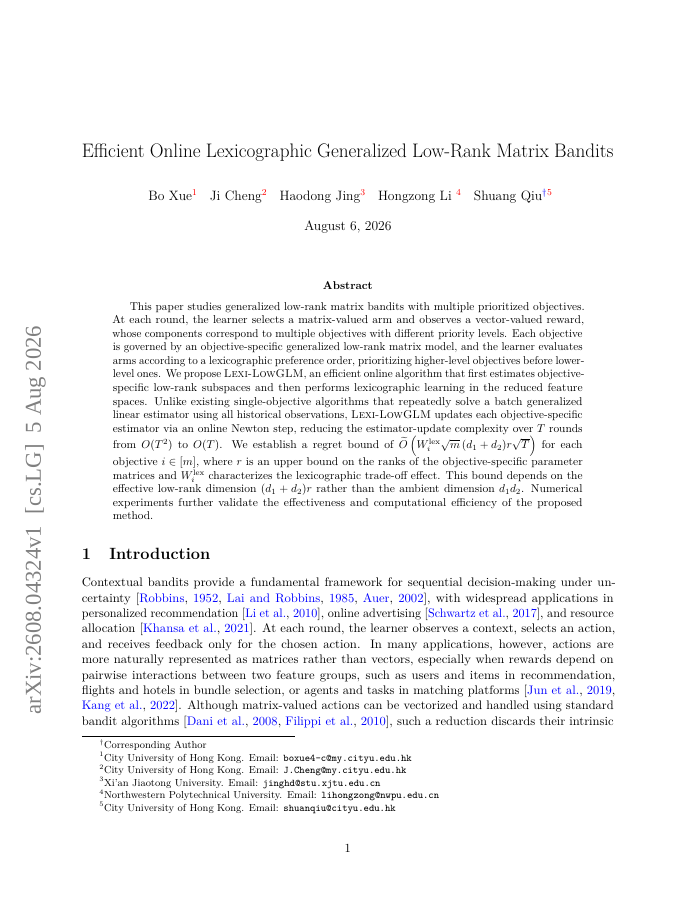
This paper studies generalized low-rank matrix bandits with multiple prioritized objectives. At each round, the learner selects a matrix-valued arm and observes a vector-valued reward, whose components correspond to multiple objectives with different priority levels. Each objective is governed by an objective-specific generalized low-rank matrix model, and the learner evaluates arms according to a lexicographic preference order, prioritizing higher-level objectives before lower-level ones. We propose Lexi-LowGLM, an efficient online algorithm that first estimates objective-specific low-rank subspaces and then performs lexicographic learning in the reduced feature spaces. Unlike existing single-objective algorithms that repeatedly solve a batch generalized linear estimator using all historical observations, Lexi-LowGLM updates each objective-specific estimator via an online Newton step, reducing the estimator-update complexity over T rounds from O(T^2) to O(T). We establish a regret bound of \widetilde O\left(W_i^{\rm lex}\sqrt{m},(d_1+d_2)r\sqrt{T}\right) for each objective i\in[m], where r is an upper bound on the ranks of the objective-specific parameter matrices and W_i^{\rm lex} characterizes the lexicographic trade-off effect. This bound depends on the effective low-rank dimension (d_1+d_2)r rather than the ambient dimension d_1d_2. Numerical experiments further validate the effectiveness and computational efficiency of the proposed method.
Efficient Online Lexicographic Generalized Low-Rank Matrix Bandits
This paper studies generalized low-rank matrix bandits with multiple prioritized objectives. At each round, the learner selects a matrix-valued arm and observes a vector-valued reward, whose components correspond to multiple objectives with different priority levels.
- Preview
- Year
- 2026
- Hosting
- Full text hostedCC-BY-4.0
Cite
Notes
Only stored in your browser.
Attribution
- Abstract & full text
- arxiv.org/abs/2608.04324CC-BY-4.0
- TL;DR
- Semantic Scholar