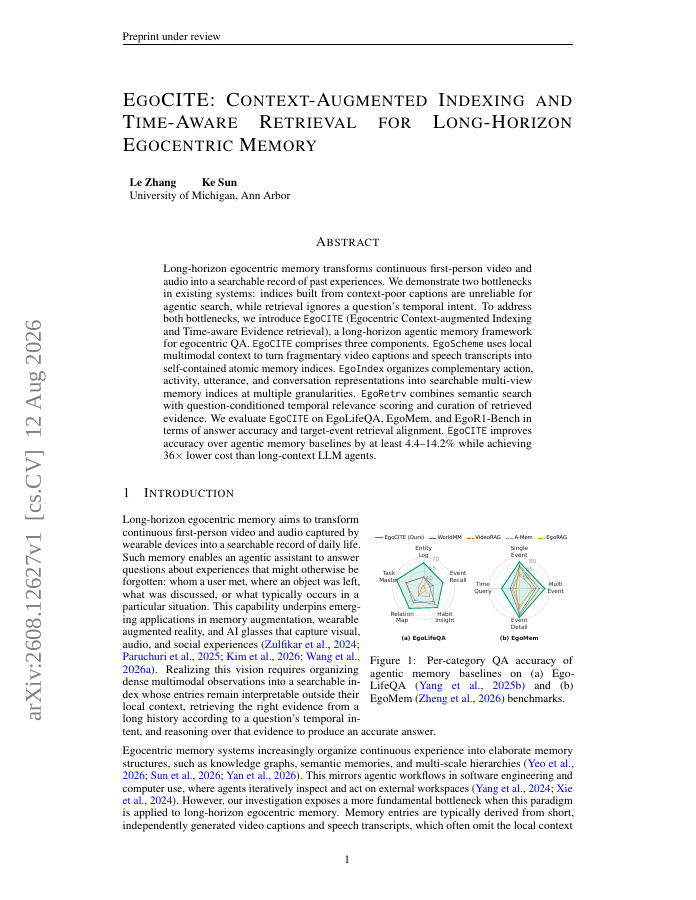
Long-horizon egocentric memory transforms continuous first-person video and audio into a searchable record of past experiences. We demonstrate two bottlenecks in existing systems: indices built from context-poor captions are unreliable for agentic search, while retrieval ignores a question's temporal intent. To address both bottlenecks, we introduce EgoCITE (Egocentric Context-augmented Indexing and Time-aware Evidence retrieval), a long-horizon agentic memory framework for egocentric QA. EgoCITE comprises three components. EgoScheme uses local multimodal context to turn fragmentary video captions and speech transcripts into self-contained atomic memory indices. EgoIndex organizes complementary action, activity, utterance, and conversation representations into searchable multi-view memory indices at multiple granularities. EgoRetrv combines semantic search with question-conditioned temporal relevance scoring and curation of retrieved evidence. We evaluate EgoCITE on EgoLifeQA, EgoMem, and EgoR1-Bench in terms of answer accuracy and target-event retrieval alignment. EgoCITE improves accuracy over agentic memory baselines by at least 4.4--14.2% while achieving 36\times lower cost than long-context LLM agents.
EgoCITE: Context-Augmented Indexing and Time-Aware Retrieval for Long-Horizon Egocentric Memory
Long-horizon egocentric memory transforms continuous first-person video and audio into a searchable record of past experiences. We demonstrate two bottlenecks in existing systems: indices built from context-poor captions are unreliable for agentic search, while retrieval ignores…
- Preview
- Year
- 2026
- Hosting
- Abstract onlyARXIV-DEFAULT
Cite
Notes
Only stored in your browser.
Attribution
- Abstract & full text
- arxiv.org/abs/2608.12627ARXIV-DEFAULT
- TL;DR
- Semantic Scholar