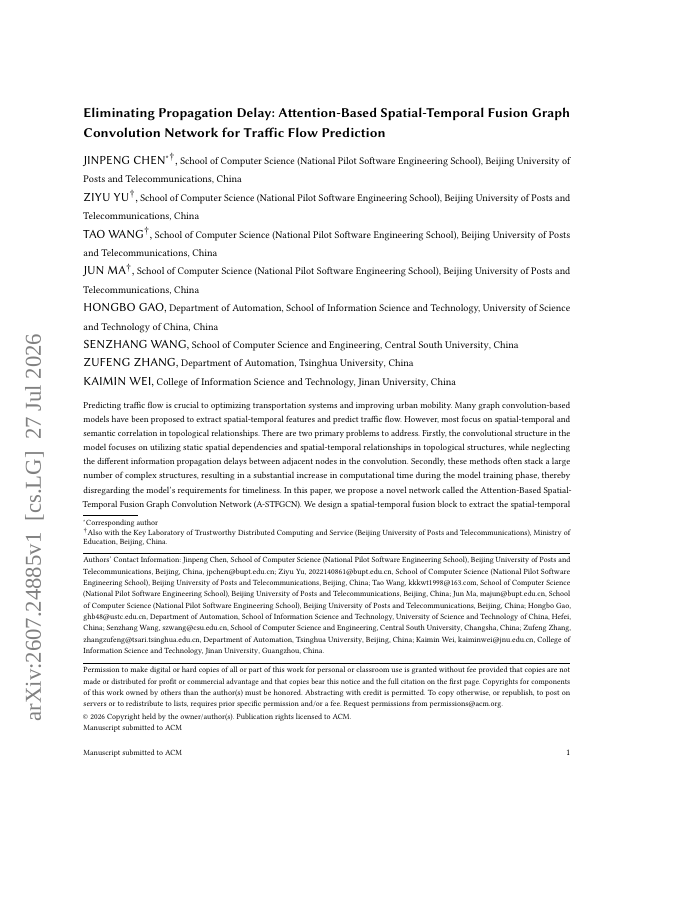
Predicting traffic flow is crucial to optimizing transportation systems and improving urban mobility. Many graph convolution-based models have been proposed to extract spatial-temporal features and predict traffic flow. However, most focus on spatial-temporal and semantic correlation in topological relationships. There are two primary problems to address. Firstly, the convolutional structure in the model focuses on utilizing static spatial dependencies and spatial-temporal relationships in topological structures, while neglecting the different information propagation delays between adjacent nodes in the convolution. Secondly, these methods often stack a large number of complex structures, resulting in a substantial increase in computational time during the model training phase, thereby disregarding the model's requirements for timeliness. In this paper, we propose a novel network called the Attention-Based Spatial-Temporal Fusion Graph Convolution Network (A-STFGCN). We design a spatial-temporal fusion block to extract the spatial-temporal feature correlations with propagation delay errors removed and to capture both long-term and short-term temporal characteristics of the data within a multi-head self-attention mechanism based on a mask matrix. Extensive experiments on five real-world datasets demonstrate that our method achieves the best overall performance while having good computation and data utilization efficiency compared with the eight baseline methods.
Eliminating Propagation Delay: Attention-Based Spatial-Temporal Fusion Graph Convolution Network for Traffic Flow Prediction
Predicting traffic flow is crucial to optimizing transportation systems and improving urban mobility. Many graph convolution-based models have been proposed to extract spatial-temporal features and predict traffic flow.
- Preview
- Year
- 2026
- Hosting
- Abstract onlyARXIV-DEFAULT
Cite
Notes
Only stored in your browser.
Attribution
- Abstract & full text
- arxiv.org/abs/2607.24885ARXIV-DEFAULT
- TL;DR
- Semantic Scholar