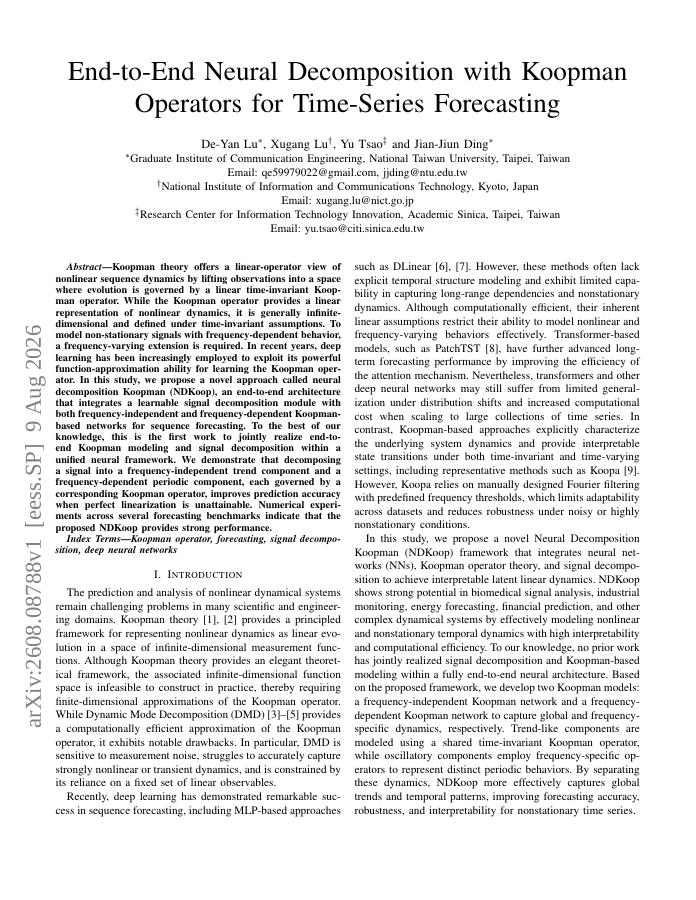
Koopman theory offers a linear-operator view of nonlinear sequence dynamics by lifting observations into a space where evolution is governed by a linear time-invariant Koopman operator. While the Koopman operator provides a linear representation of nonlinear dynamics, it is generally infinite dimensional and defined under time-invariant assumptions. To model non-stationary signals with frequency-dependent behavior, a frequency-varying extension is required. In recent years, deep learning has been increasingly employed to exploit its powerful function-approximation ability for learning the Koopman operator. In this study, we propose a novel approach called neural decomposition Koopman (NDKoop), an end-to-end architecture that integrates a learnable signal decomposition module with both frequency-independent and frequency-dependent Koopman based networks for sequence forecasting. To the best of our knowledge, this is the first work to jointly realize end-to end Koopman modeling and signal decomposition within a unified neural framework. We demonstrate that decomposing a signal into a frequency-independent trend component and a frequency-dependent periodic component, each governed by a corresponding Koopman operator, improves prediction accuracy when perfect linearization is unattainable. Numerical experiments across several forecasting benchmarks indicate that the proposed NDKoop provides strong performance.
End-to-End Neural Decomposition with Koopman Operators for Time-Series Forecasting
Koopman theory offers a linear-operator view of nonlinear sequence dynamics by lifting observations into a space where evolution is governed by a linear time-invariant Koopman operator.
- Preview
- Year
- 2026
- Hosting
- Abstract onlyARXIV-DEFAULT
Cite
Notes
Only stored in your browser.
Attribution
- Abstract & full text
- arxiv.org/abs/2608.08788ARXIV-DEFAULT
- TL;DR
- Semantic Scholar