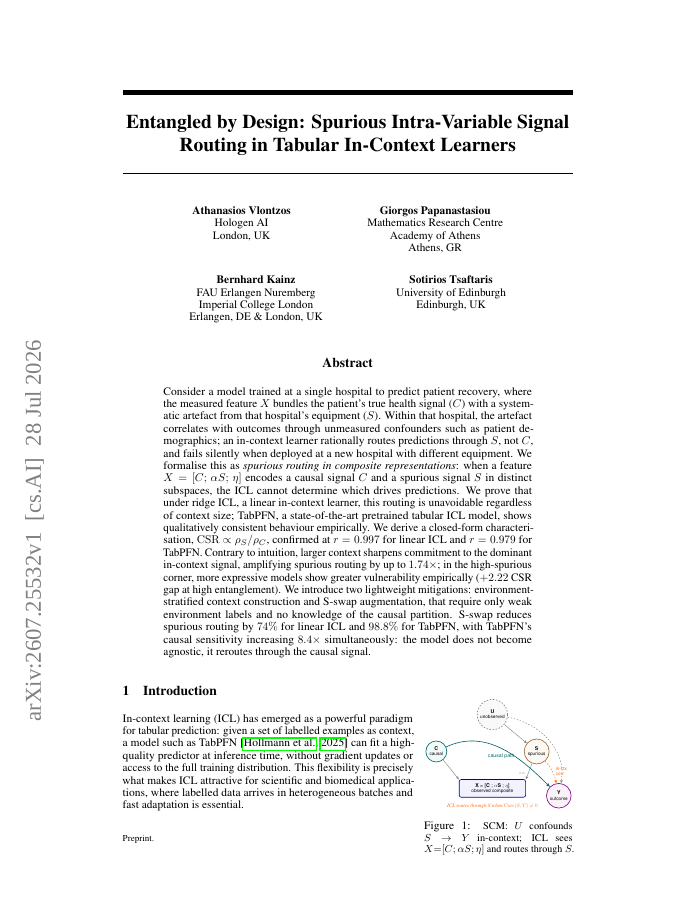
Consider a model trained at a single hospital to predict patient recovery, where the measured feature X bundles the patient's true health signal (C) with a systematic artefact from that hospital's equipment (S). Within that hospital, the artefact correlates with outcomes through unmeasured confounders such as patient demographics; an in-context learner rationally routes predictions through S, not C, and fails silently when deployed at a new hospital with different equipment. We formalise this as spurious routing in composite representations: when a feature X = [C;,αS;,η] encodes a causal signal C and a spurious signal S in distinct subspaces, the ICL cannot determine which drives predictions. We prove that under ridge ICL, a linear in-context learner, this routing is unavoidable regardless of context size; TabPFN, a state-of-the-art pretrained tabular ICL model, shows qualitatively consistent behaviour empirically. We derive a closed-form characterisation, CSR \propto ρ_S/ρ_C, confirmed at r = 0.997 for linear ICL and r = 0.979 for TabPFN. Contrary to intuition, larger context sharpens commitment to the dominant in-context signal, amplifying spurious routing by up to 1.74\times; in the high-spurious corner, more expressive models show greater vulnerability empirically (+2.22 CSR gap at high entanglement). We introduce two lightweight mitigations: environment-stratified context construction and S-swap augmentation, that require only weak environment labels and no knowledge of the causal partition. S-swap reduces spurious routing by 74% for linear ICL and 98.8% for TabPFN, with TabPFN's causal sensitivity increasing 8.4\times simultaneously: the model does not become agnostic, it reroutes through the causal signal.
Entangled by Design: Spurious Intra-Variable Signal Routing in Tabular In-Context Learners
Consider a model trained at a single hospital to predict patient recovery, where the measured feature $X$ bundles the patient's true health signal ($C$) with a systematic artefact from that hospital's equipment ($S$).
- Preview
- Year
- 2026
- Hosting
- Full text hostedCC-BY-4.0
Cite
Notes
Only stored in your browser.
Attribution
- Abstract & full text
- arxiv.org/abs/2607.25532CC-BY-4.0
- TL;DR
- Semantic Scholar