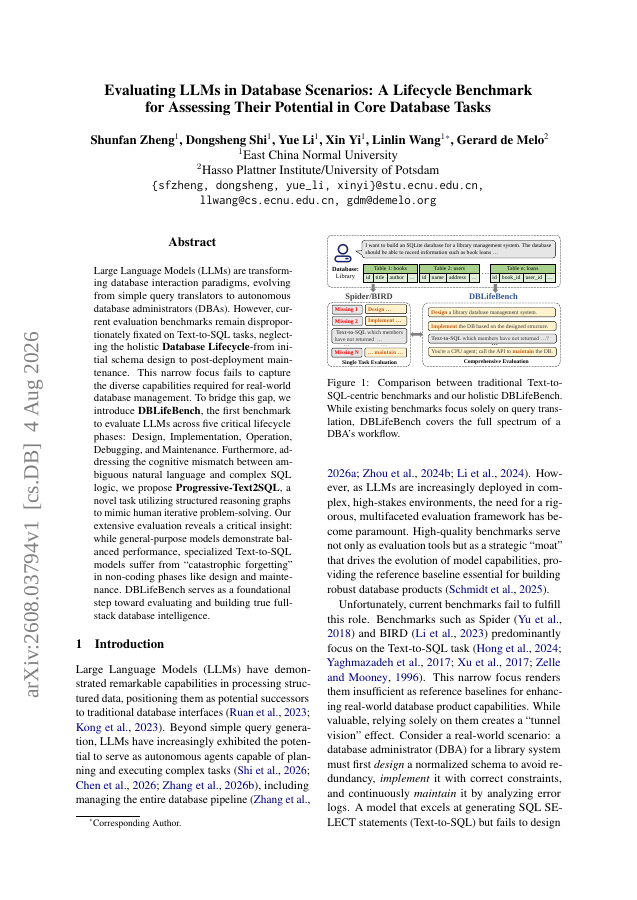
Large Language Models (LLMs) are transforming database interaction paradigms, evolving from simple query translators to autonomous database administrators (DBAs). However, current evaluation benchmarks remain disproportionately fixated on Text-to-SQL tasks, neglecting the holistic Database Lifecycle-from initial schema design to post-deployment maintenance. This narrow focus fails to capture the diverse capabilities required for real-world database management. To bridge this gap, we introduce DBLifeBench, the first benchmark to evaluate LLMs across five critical lifecycle phases: Design, Implementation, Operation, Debugging, and Maintenance. Furthermore, addressing the cognitive mismatch between ambiguous natural language and complex SQL logic, we propose Progressive-Text2SQL, a novel task utilizing structured reasoning graphs to mimic human iterative problem-solving. Our extensive evaluation reveals a critical insight: while general-purpose models demonstrate balanced performance, specialized Text-to-SQL models suffer from ``catastrophic forgetting'' in non-coding phases like design and maintenance. DBLifeBench serves as a foundational step toward evaluating and building true full-stack database intelligence.
Evaluating LLMs in Database Scenarios: A Lifecycle Benchmark for Assessing Their Potential in Core Database Tasks
Large Language Models (LLMs) are transforming database interaction paradigms, evolving from simple query translators to autonomous database administrators (DBAs). However, current evaluation benchmarks remain disproportionately fixated on Text-to-SQL tasks, neglecting the…
- Preview
- Year
- 2026
- Hosting
- Abstract onlyARXIV-DEFAULT
Cite
Notes
Only stored in your browser.
Attribution
- Abstract & full text
- arxiv.org/abs/2608.03794ARXIV-DEFAULT
- TL;DR
- Semantic Scholar