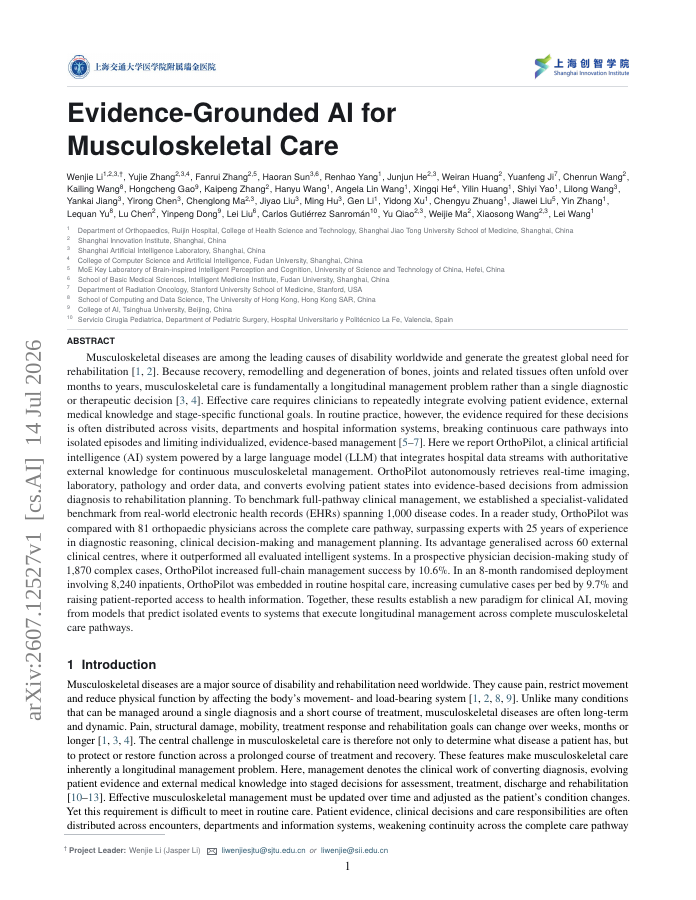
Musculoskeletal diseases are among the leading causes of disability and drive the greatest global need for rehabilitation. Because recovery, remodelling and degeneration of bones, joints and related tissues unfold over months to years, care requires longitudinal management rather than isolated decisions. Clinicians must repeatedly integrate evolving patient evidence, medical knowledge and stage-specific functional goals, yet evidence is often fragmented across visits, departments and hospital systems, disrupting continuous, individualised management. Here we report OrthoPilot, a clinical artificial intelligence (AI) system powered by a large language model (LLM) that integrates hospital data streams with authoritative external knowledge for continuous musculoskeletal care. It autonomously retrieves real-time imaging, laboratory, pathology and order data and translates evolving patient states into evidence-based decisions from admission diagnosis through rehabilitation planning. We established a specialist-validated benchmark from real-world electronic health records (EHRs) spanning 1,000 disease codes. In a full-pathway reader study against 81 orthopaedic physicians, OrthoPilot outperformed experts with 25 years of experience in diagnostic reasoning, clinical decision-making and management planning. This advantage generalised across 60 external clinical centres, where OrthoPilot surpassed all evaluated intelligent systems. In a prospective physician decision-making study of 1,870 complex cases, OrthoPilot improved full-chain management success by 10.6%. In a randomised deployment involving 8,240 inpatients, integration into routine care increased cumulative cases per bed by 9.7% and improved patient-reported access to health information. These results move clinical AI from predicting isolated events toward executing longitudinal management across complete musculoskeletal care pathways.
Evidence-Grounded AI for Musculoskeletal Care
Musculoskeletal diseases are among the leading causes of disability and drive the greatest global need for rehabilitation. Because recovery, remodelling and degeneration of bones, joints and related tissues unfold over months to years, care requires longitudinal management…
- Preview
- Year
- 2026
- Hosting
- Abstract onlyARXIV-DEFAULT
Cite
Notes
Only stored in your browser.
Attribution
- Abstract & full text
- arxiv.org/abs/2607.12527ARXIV-DEFAULT
- TL;DR
- Semantic Scholar