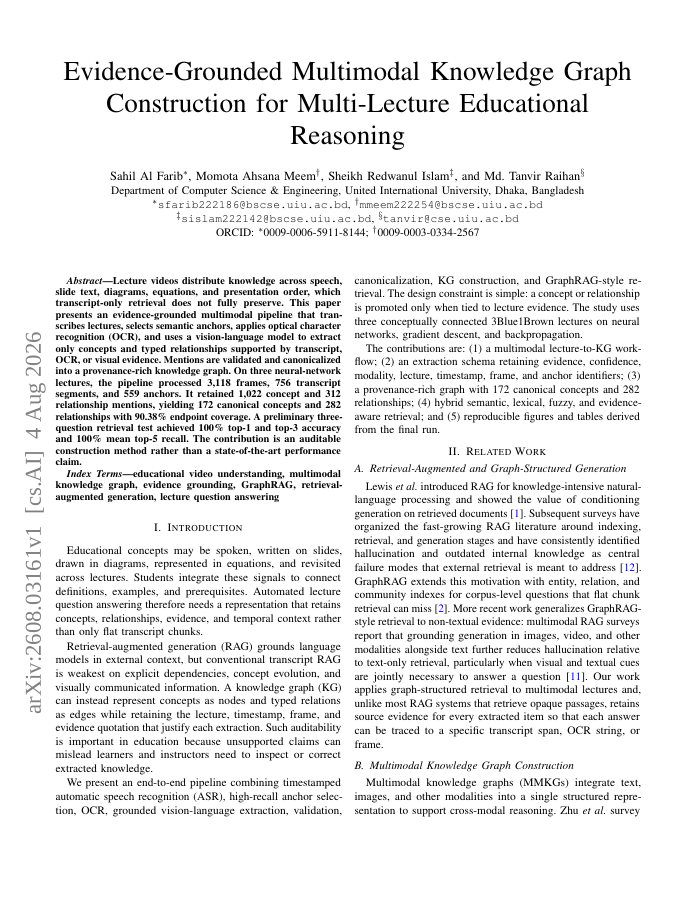
Lecture videos distribute knowledge across speech, slide text, diagrams, equations, and presentation order, which transcript-only retrieval does not fully preserve. This paper presents an evidence-grounded multimodal pipeline that transcribes lectures, selects semantic anchors, applies optical character recognition (OCR), and uses a vision-language model to extract only concepts and typed relationships supported by transcript, OCR, or visual evidence. Mentions are validated and canonicalized into a provenance-rich knowledge graph. On three neural-network lectures, the pipeline processed 3,118 frames, 756 transcript segments, and 559 anchors. It retained 1,022 concept and 312 relationship mentions, yielding 172 canonical concepts and 282 relationships with 90.38% endpoint coverage. A preliminary three question retrieval test achieved 100% top-1 and top-3 accuracy and 100% mean top-5 recall. The contribution is an auditable construction method rather than a state-of-the-art performance claim.
Evidence-Grounded Multimodal Knowledge Graph Construction for Multi-Lecture Educational Reasoning
Lecture videos distribute knowledge across speech, slide text, diagrams, equations, and presentation order, which transcript-only retrieval does not fully preserve. This paper presents an evidence-grounded multimodal pipeline that transcribes lectures, selects semantic anchors,…
- Preview
- Year
- 2026
- Hosting
- Full text hostedCC-BY-4.0
Cite
Notes
Only stored in your browser.
Attribution
- Abstract & full text
- arxiv.org/abs/2608.03161CC-BY-4.0
- TL;DR
- Semantic Scholar