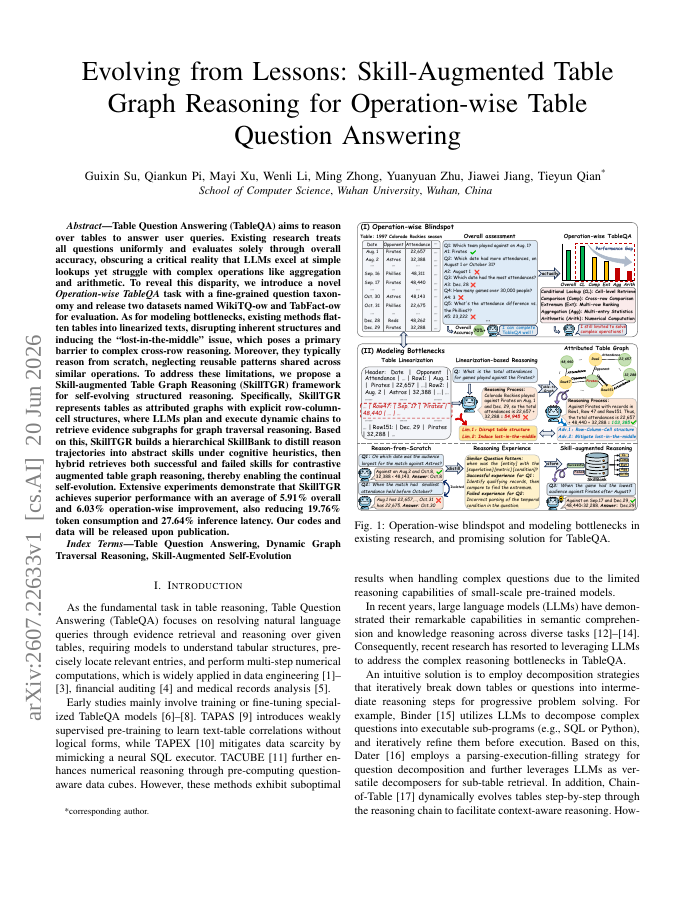
Table Question Answering (TableQA) aims to reason over tables to answer user queries. Existing research treats all questions uniformly and evaluates solely through overall accuracy, obscuring a critical reality that LLMs excel at simple lookups yet struggle with complex operations like aggregation and arithmetic. To reveal this disparity, we introduce a novel Operation-wise TableQA task with a fine-grained question taxonomy and release two datasets named WikiTQ-ow and TabFact-ow for evaluation. As for modeling bottlenecks, existing methods flatten tables into linearized texts, disrupting inherent structures and inducing the ``lost-in-the-middle'' issue, which poses a primary barrier to complex cross-row reasoning. Moreover, they typically reason from scratch, neglecting reusable patterns shared across similar operations. To address these limitations, we propose a Skill-augmented Table Graph Reasoning (SkillTGR) framework for self-evolving structured reasoning. Specifically, SkillTGR represents tables as attributed graphs with explicit row-column-cell structures, where LLMs plan and execute dynamic chains to retrieve evidence subgraphs for graph traversal reasoning. Based on this, SkillTGR builds a hierarchical SkillBank to distill reason trajectories into abstract skills under cognitive heuristics, then hybrid retrieves both successful and failed skills for contrastive augmented table graph reasoning, thereby enabling the continual self-evolution. Extensive experiments demonstrate that SkillTGR achieves superior performance with an average of 5.91% overall and 6.03% operation-wise improvement, also reducing 19.76% token consumption and 27.64% inference latency. Our codes and data will be released upon publication.
Evolving from Lessons: Skill-Augmented Table Graph Reasoning for Operation-wise Table Question Answering
Table Question Answering (TableQA) aims to reason over tables to answer user queries. Existing research treats all questions uniformly and evaluates solely through overall accuracy, obscuring a critical reality that LLMs excel at simple lookups yet struggle with complex…
- Preview
- Year
- 2026
- Hosting
- Full text hostedCC-BY-4.0
Cite
Notes
Only stored in your browser.
Attribution
- Abstract & full text
- arxiv.org/abs/2607.22633CC-BY-4.0
- TL;DR
- Semantic Scholar