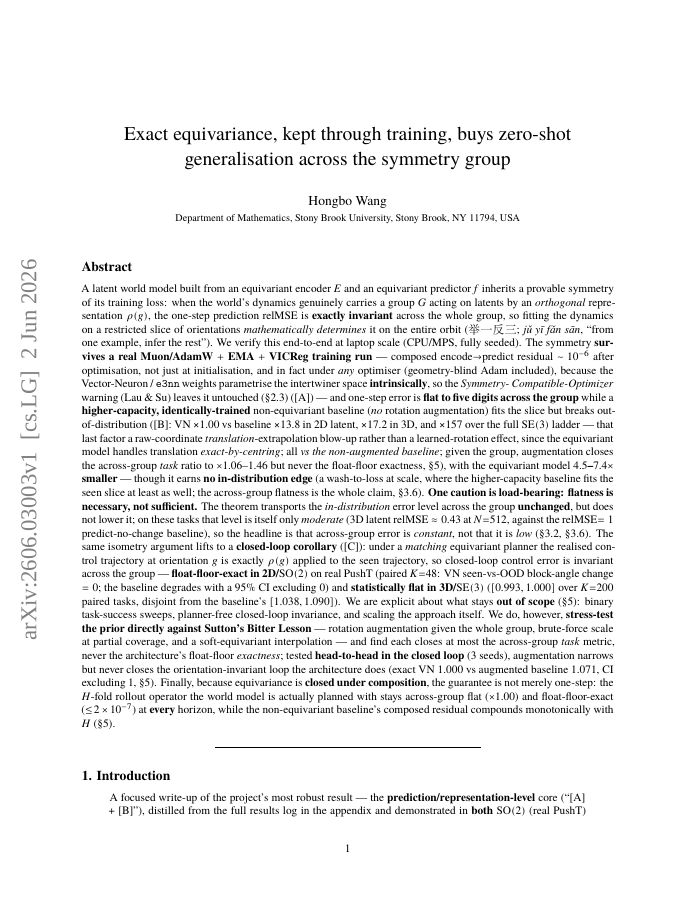
A latent world model built from an equivariant encoder and predictor inherits a provable symmetry of its training loss: when the dynamics carries a group G acting on latents by an orthogonal representation ρ(g), the one-step prediction relMSE is exactly invariant across the whole group, so fitting a restricted slice of orientations mathematically determines it on the entire orbit. The symmetry survives a real Muon/AdamW+EMA+VICReg run -- composed residual \sim 10^{-6} after training, under any optimiser (intrinsic Vector-Neuron/e3nn parametrisation) -- and one-step error is flat across the group (5-seed medians: equivariant \times 1.00 vs a higher-capacity non-equivariant baseline \times 12.7 in 2D, \times 17.2 in 3D), while that baseline fits the slice but breaks out-of-distribution. The flatness is not a synthetic artefact: on real-robot DROID end-effector trajectories the equivariant model stays flat across the orbit (\times 1.000, rotation residual 1.5\times 10^{-16}) while a 4.5\times-larger baseline degrades \times 11. One caution is load-bearing: flatness is necessary, not sufficient -- the theorem transports the in-distribution error level unchanged but does not lower it (3D relMSE \approx 0.43): across-group error is constant, not low. The same isometry lifts to a closed-loop corollary: under a matching equivariant planner the control error is invariant across the group -- float-floor-exact in 2D/SO(2), statistically flat in 3D/SE(3). Stress-tested against Sutton's Bitter Lesson (augmentation, scale, soft-equivariance), each closes at most the across-group task metric, never the float-floor exactness. This is the generalisation-side foundation of a certified-world-models programme (arXiv:2606.13092, 2606.24945, 2606.24946): flatness transports competence, and the trust bounds built on it are downstream products.
Exact equivariance, kept through training, buys zero-shot generalisation across the symmetry group
A latent world model built from an equivariant encoder and predictor inherits a provable symmetry of its training loss: when the dynamics carries a group $G$ acting on latents by an orthogonal representation $ρ(g)$, the one-step prediction relMSE is exactly invariant across the…
- Preview
- Year
- 2026
- Hosting
- Full text hostedCC-BY-4.0
Cite
Notes
Only stored in your browser.
Attribution
- Abstract & full text
- arxiv.org/abs/2606.03003CC-BY-4.0
- TL;DR
- Semantic Scholar