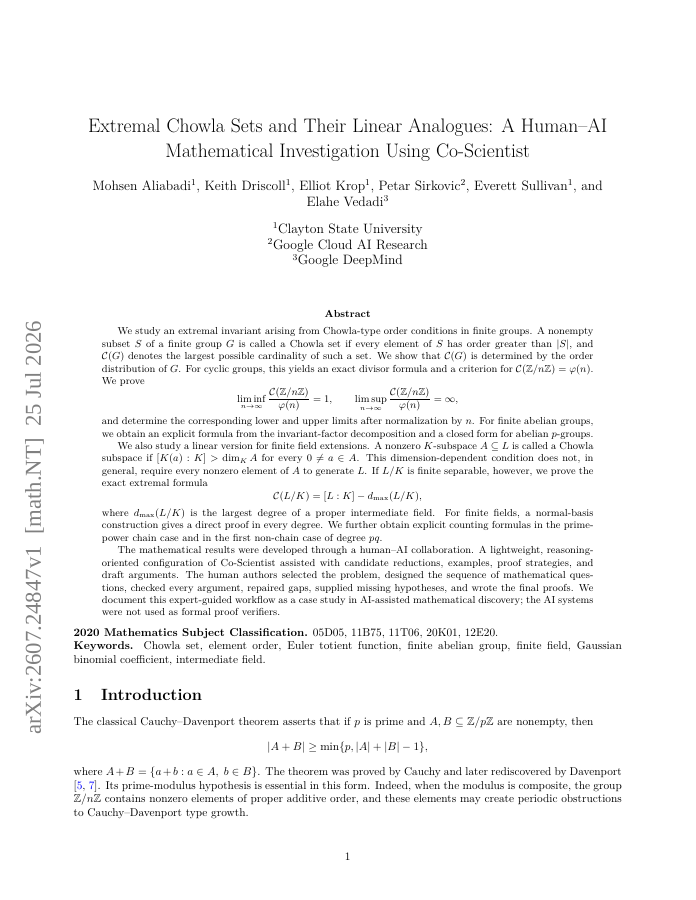
We introduce an extremal invariant associated with Chowla-type order conditions in finite groups. A nonempty subset S of a finite group G is called a Chowla set if every element of S has order greater than |S|, and we write \Ccal(G) for the maximum cardinality of such a set. We first show that \Ccal(G) is determined by the distribution of element orders in G. For cyclic groups, we derive an exact divisor formula and characterize the integers n for which \Ccal(\mathbb Z/n\mathbb Z)=φ(n). We prove that \liminf_{n\to\infty}\Ccal(\mathbb Z/n\mathbb Z)/φ(n)=1, whereas \limsup_{n\to\infty}\Ccal(\mathbb Z/n\mathbb Z)/φ(n)=\infty, and we determine the corresponding lower and upper limits under normalization by n. For finite abelian groups, we obtain an explicit formula in terms of the invariant-factor decomposition, together with a closed formula for finite abelian p-groups. We then develop a linear analogue for finite field extensions. A nonzero K-subspace A of an extension L/K is called a Chowla subspace if [K(a):K]>\dim_K A for every nonzero a\in A. Since this condition depends on \dim_K A, it does not generally require every nonzero element of A to generate L over K. Nevertheless, when L/K is finite and separable, we prove the exact formula \Ccal(L/K)=[L:K]-d_{\max}(L/K), where d_{\max}(L/K) is the largest degree over K of a proper intermediate field. For finite fields, we give a direct proof in every degree using a normal-basis construction. This work was developed through an expert-guided human--AI collaboration. A reasoning-focused configuration of Co-Scientist was used to explore examples and potential proof strategies. The authors formulated the problem, independently verified and completed all arguments, and wrote the final proofs.
Extremal Chowla sets and their linear analogues: A human-AI mathematical investigation using Co-Scientist
We introduce an extremal invariant associated with Chowla-type order conditions in finite groups. A nonempty subset $S$ of a finite group $G$ is called a Chowla set if every element of $S$ has order greater than $|S|$, and we write $\Ccal(G)$ for the maximum cardinality of such…
- Preview
- Year
- 2026
- Hosting
- Abstract onlyARXIV-DEFAULT
Cite
Notes
Only stored in your browser.
Attribution
- Abstract & full text
- arxiv.org/abs/2607.24847ARXIV-DEFAULT
- TL;DR
- Semantic Scholar